Coupe Quattro and 90 Quattro cars with Audi 7A 20V engine

AvtoAd
05/12/2022
Content
6. Wheels/Tires/Suspension/Steering wheel.
8. Standard functions (coupe).
Engine characteristics
| Type | In-line 5-cylinder 20-valve, longitudinally installed |
| Moving | 141 cubic meters in., 2309 cubic cm |
| Compression ratio | 10.3:1 |
| Horsepower (SAE) | 164 hp at 6000 rpm |
| Torque (SAE) | 157 lb-ft at 4,500 rpm |
| Materials | Cast iron block, aluminum alloy head, forged crankshaft |
| Valve mechanism | Dual overhead cam, hydraulic lifters, 4 per cylinder, sodium filled |
| Firing order |
1 - 2 - 4 - 5 - 3 |
|
Fuel injection/ignition |
EFI, Dual Map Electronic Ignition, selective control of cylinder detonation using dual detonation sensors |
Torque curve

Transmission
|
|
|||||||||||||||||||||||||
|
Type |
All-wheel drive Audi Quattro (generation II) |
||||||||||||||||||||||||
| Method of transmission | 5-speed mechanics | ||||||||||||||||||||||||
|
Transmission numbers |
|
||||||||||||||||||||||||
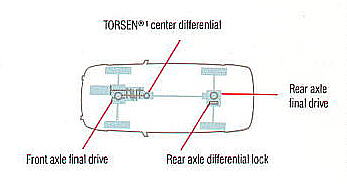
| Differentials | Front part: open Center: TORSEN (TORque SENsing) Rear: Manual locking - automatic disconnection |
||||||||||||||||||||||||
Brakes |
|
| Type | 4-wheel disc, 3-channel ABS, hydraulic support, double diagonal contours |
| Front |
(Coupe) Vented 276 mm (10.9 in.) rotors, two-piston caliper (Sedan) Vented rotors 256 mm (10.1 in), Single piston caliper |
|
Back |
Solid 245 mm (9.6 in.) rotors, single piston caliper |
Productivity/Economy
|
|
||
|
|
Compartment |
Sedan |
| 0-60 mph | 8.1s (Audi) 9.0s (Motor Trend, September '89) 8.8 s (Motor Trend, January 1991) 8.7 s (car and driver) 9.0 s (road and track) |
8.1s (Audi)7.9s (car and driver) |
| The highest speed | 136 mph (Audi) 133 mph (car and driver) |
135 mph (Audi) 137 mph (car and driver) |
| 1/4 mile | 16.7 s / 83.7 mph (Motor Trend, September 1989) 16.5 s / 84.7 mph (Motor Trend, January 1991) 16.5 s / 85 mph (Car and Driver) 16.7 s / 82.0 mph (Road and Track) |
16.0 s / 87 mph (Car and Driver) |
| 60- 0 mph | 138 feet. (Motor Trend, September 1989) 139 feet (Motor Trend, Jan 91) 158 feet (road and track) |
[70-0 mph] 179 feet (car and driver) |
| Lateral acceleration |
0.84 g (Motor Trend, September 1989) 0.81 g (Motor Trend, January '91) 0.79 g (car and driver) 0.79 g (road and track) |
0.80 g (car and driver) |
| MPG | 18 city/24 highway | 18 city/24 highway |
| Aerodynamics | 0.36 Cd |
|
Note: Motor Trend, Car and Driver and Road and Track vehicles were equipped with California emissions.
Wheels/tires/suspension/steering wheel
|
|
|
| Wheels | (Coupe) Speedline Aluminum Alloy, 15"x7", 37mm Offset, Bolt Pattern 4x10⁸ (Sedan) Or 14"x6" BBS Mesh or 15"x7" Speedline, 45mm Offset, Bolt Pattern 4x10⁸ |
| Tires | (Coupe) Standard: 205/60 15 (V rated), Optional All Season: 195/65 15 M+S ( Sedan ) Either 195/60 14 on BBS or 205/50 15 (rated V) on Speedline |
| Pendant | 4-Wheel Independent, Coil Spring/Gas Shock, Lower Control Arm, Front Sway Bar, Rear Sway Bar (Later Models) |
| Steering | Hydraulic rack and pinion with variable support |
Weight/Dimensions
|
|
||
|
|
Compartment | Sedan |
| Equipped mass | 1990 - 3,174 lb (1,440 kg) 1991 - 3308 lb (1500 kg) |
1990 - 3,042 lb (1,380 kg) 1991 - 3197 lb (1450 kg) |
| Wheel base | 100.4 inches. ( 2549 mm ) |
99.9 inches. ( 2537 mm ) |
|
Track |
Front: 57.1 inches. (1451 mm) |
|
|
Length |
176 inches. (4470 mm) |
176.3 inches. (4478 mm) |
| Width | 67.6 inches. (1716 mm) |
|
|
Height (without load) |
54.3 inches. (1380 mm) |
|
| Ground clearance (with load) |
5.4 inches. (136 mm) |
|
|
Weight distribution (F/R %) |
58 / 42 |
|
Standard Features (Coupe)
- 2.25" stainless steel exhaust, 2" dual tips.
- The structure of the unit body is made of galvanized sheet metal (all panels, both sides).
- Front and rear fog lights.
- Headlight washers.
- Side mirror fogging.
- Automatic front seat belt tensioners (PROCON TEN system in the photo on the right).
- Rear 3-point seat belts.
- Driver's Side Airbag (September 1, 1989) -- (Coupe) begins with chassis #1109, (Sedan).
- Leather upholstery, steering wheel and gearbox boot.
- The wood finish is collected, the wooden gear shift knob.
- 6-function trip computer.
- 9-function Auto-Check system.
- Anti-theft alarm system.
- Electric windows (lowering by the driver with one touch), door locks, revolving sunroof (glass on coupe 91).
- Fiberglass rear cover with built-in window (coupe).
- Rear spoiler (sedan).
- Cruise control.
- Electronic climate control.
- Audio system with 6 speakers.
- Split folding rear seats (coupé) with integrated pass-through ski bag.
- How could I forget the excellent quattro all-wheel drive system (generation II).
Options (coupe)
- Electric adjustment of the front seats in 8 directions, memory in 4 positions for the driver's seat.
- Cold weather package: heated front seats, heated windshield washer jets and heated door locks.
- Pearl white metallic.
- California emissions package.
Did you find a sticker with the characteristics and color codes in the trunk? Now you can decipher them by looking at these detail tables.
Changes started
- Cars without airbags have a luggage rack in front of the driver's lap.
- Crossbeams changed from front to front and rear, starting with coupe chassis #3682, Sedan chassis.
- Various parts of the hydraulic system have been changed, starting with coupe chassis #6901 (built in October 1989). They changed again for the '91 model.
- The tubular stainless steel exhaust manifold was replaced with a cast iron manifold beginning with coupe chassis #13611 (built March 1990).
- ECU changed P/N starting with coupe chassis #15001 (build March 1990).
- The older ECU uses the simple VAG 1115 diagnostic tool (which you build with a diode), the newer one supposedly requires the expensive VAG 1551, but I believe the 1115 will still work (instructions coming soon).
- Sunroof changed from steel to smoked glass for the 1991 model year.
Sales in North America
|
|
Compartment | Sedan |
| 1989 year | 461 | ? |
|
1990 year |
847 |
? |
| 1991 year |
364 |
? |
| 1992 year | 58 |
? |
| In total | 1730 year |
? |
This is a small number compared to the total of 73,858 B3 coupes (FWD and Q) from 9/87 to 1/96.
VIN decoding
Information borrowed from European Precision. Their website has the codes for most other Audi VINs, although there are some differences.
|
Description |
1990 CoupeQ |
1991 90Q |
| Country (W = Germany) |
IN |
IN |
|
Manufacturer (AU = Audi) |
AND |
AND |
| Series (G = CoupeQ*, H = 90Q) |
G |
Kh |
|
Engine (D = very early**) |
D |
E
|
| Restraint (0 = active [PROCON TEN], 5 = Driver's airbag) |
0 |
5 |
|
Model (8B = CoupeQ, 8A = 90Q) |
8 B |
8 |
| Check digit (no sense) |
# |
# |
| Model year (L = 1990, M = 1991) | L |
M |
| Assembly plant (A = Ingolstadt) | AND |
AND |
|
The serial number (each vehicle is assigned a unique number) |
# # # # # # |
# # # # # # |
* The parts sheet says the letter for the CoupeQ should be "K", but all I know are "G".
** I don't know the difference between the "D" and "E" engine designations, but "D" engines are found in early coupes (probably early 90s as well, but I haven't found an early example). The changes took place sometime in July 1989. However, the engine identification "7A" is used for both versions.