Audi A3 Sportback e-tron

AvtoAd
10/09/2022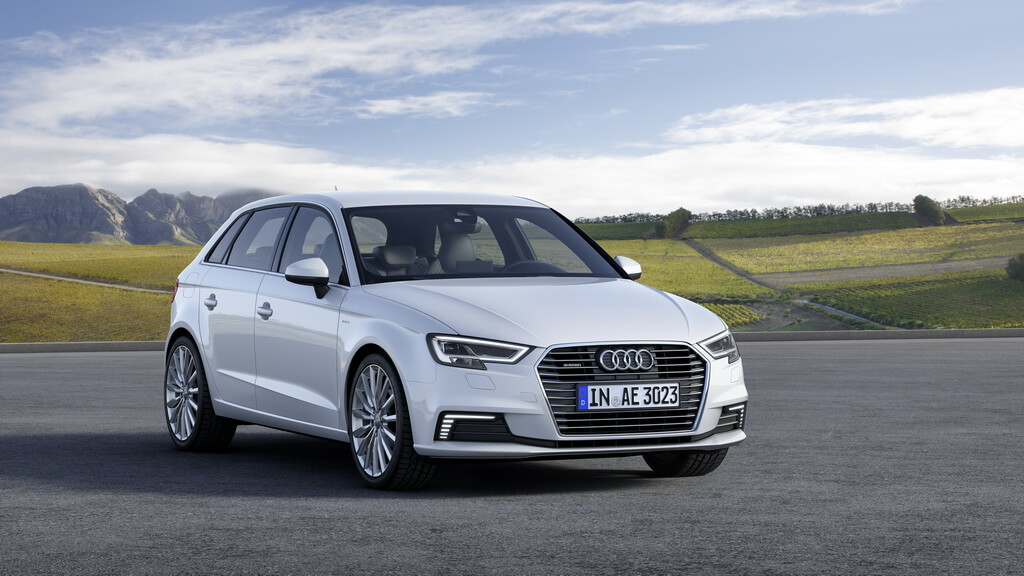
First drive: US-spec Audi A3 Sportback e-tron hybrid; 83-86 MPGe with 16-17 mile EV range
More than two and a half years after the car was first announced ( previous post ) and more than a year after it went on sale in Germany and Central Europe ( previous post ), the US-spec Audi A3 Sportback e-tron plug-in hybrid will begin arriving in US showrooms in the next few weeks.
While the EPA hasn't released final fuel economy figures for the U.S. A3 e-tron, Philip Brabeck, director of product management at Audi of America, said the numbers will be around 83 to 86 MPGe combined (depending on trim level) with just the 35 to 39 mpg gas and 16 to 17 EV miles. The A3 e-tron can go up to 80 mph in all-electric mode; a spec we were happy to confirm last week during a media drive in the San Francisco Bay Area.

The A3 Sportback e-tron accelerates from 0 to 70 in a respectable 7.6 seconds, which is comparable to the 7.4 seconds of the 2016 A3 Cabriolet (1.8 TFSI), and quicker than the current A3 TDI (8.1 seconds ), but slower than the A3 2.0T (5.9 seconds) and the very sporty S3 (4.7 seconds). Top speed for the A3 Sportback e-tron is 130 mph.
The Audi A3 Sportback e-tron is a parallel drive hybrid consisting of a modified 1.4 TFSI that develops 110 kW (150 hp) and 250 N·m (184 lb-ft) of torque; a six-speed S tronic transmission integrated with a 75 kW, 330 N·m (243 lb-ft) permanent magnet liquid-cooled electric motor; and an 8.8kWh liquid-cooled lithium-ion battery that sits under the rear seat. The power of the system is 204 hp. (152 kW) and 258 lb-ft (350 N·m) of torque.
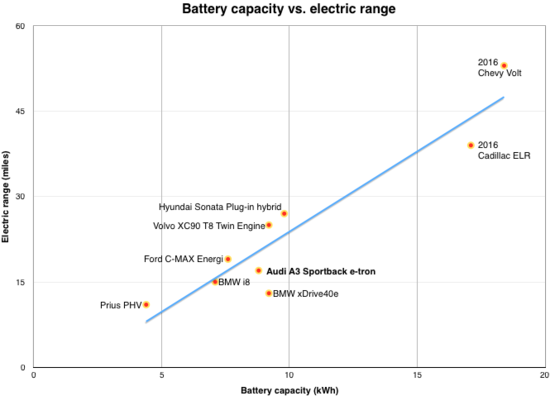
Battery capacity versus electric range for select PHEVs in the US. A3 e-tron is included in the medium-sized battery cluster (7-10 kWh).
The A3 Sportback e-tron plug-in hybrid is the first electrified Audi sold in the U.S. and the first step toward an electrified future for Audi here, combining Audi's premium driving experience with the efficiency of an electric motor. (Audi executives insist this is the first of many Audi e-tron models coming to the US, among them the upcoming production version of the very attractive e-tron quattro ( previous post ), which was designed with the US market in mind and with USA, Brabek said.)
The car is solidly built and drives as you'd expect from an Audi. The front suspension is a MacPherson strut with A-arms and aluminum ball bearings connected to an aluminum subframe. The electromechanical steering system works together with various auxiliary systems to reduce mechanical resistance for greater efficiency.
In the four-link rear suspension, which uses a steel cross member, the springs and shock absorbers are mounted separately. The Electronic Stability Program (ESC) also includes an electronic differential lock and secondary braking assistance in the event of a collision. When cornering, it can brake the inside front wheel very lightly to minimize understeer and improve traction.
As a result, steering is light and cornering at higher speeds is stable, without the extra weight of a battery pack in the back. Driving on narrow, winding, up and down, and sometimes narrow roads, the A3 Sportback e-tron stayed planted to the pavement on its line through tight corners at speed.
One of the most impressive driving characteristics of the A3 Sportback e-tron is the extremely smooth transition between engine and engine... smooth to the point of being unnoticeable apart from the sound of the engine. Audi engineers achieved this thanks to the design of the drive itself and the control software.
Drive unit. The disc-shaped electric motor is integrated into the six-speed eS tronic, which transmits power to the front wheels. The two power plants complement each other. The electric motor develops maximum torque from the start until around 2,000 rpm, and the TFSI's maximum pulling power is available between 1,750 and 4,000 rpm.
One of the biggest engineering efforts we've put into this car is the conversion of the electric motor to combustion and back. It was very important for us to make sure it wasn't harsh and didn't have any compromises.
I'll just give an example. When we start an engine with an electric motor, we increase the power of the electric motor to make the engine start. We have a clutch that engages and engages the two, which starts the engine. As soon as the oil pressure reaches a sufficient level, we start the engine at zero load, after which we disconnect both again. As soon as the engine catches up with the required speed of the electric motor, we turn on again. In this way, we guarantee that the transition will be very smooth.
— Philip Brabeck
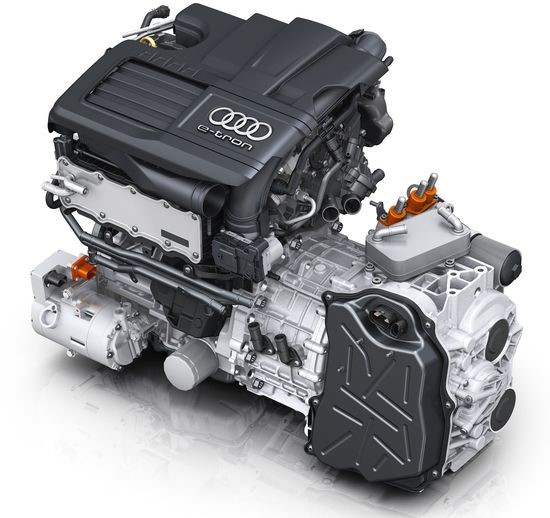
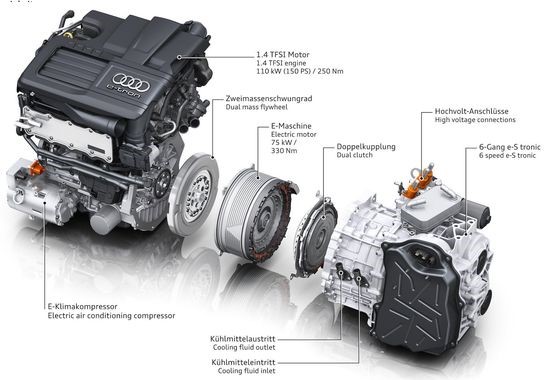
Top: transversely mounted drive. Below: the main components.
The four-cylinder engine is equipped with a turbocharger with electric bypass and a temperature control system that uses a high-performance coolant pump module. Its heart is the exhaust manifold built into the cylinder head. It quickly warms up the engine after a cold start, and at high load, the water jacket reduces the temperature of the exhaust gases. The coolant circuit for the TFSI also includes an oil cooler for the S tronic.
The A3 Sportback e-tron hybrid concept often does not turn on the internal combustion engine until the moment of "kickdown", even when it is cold. That's why the A3 Sportback e-tron has special protective elements such as piston rings and coated bearings.
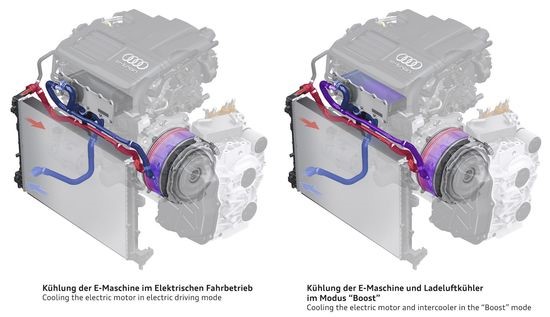
An electric motor is a synchronous machine of permanent excitation. It weighs 34 kilograms (75.0 lb) and is liquid cooled using a cooling jacket in the stator. The electric motor is located behind the dual-mass engine flywheel and includes a disconnector. When the internal combustion engine starts, it is towed by the electric motor through the clutch. As soon as it reaches the same speed as the electric motor, the clutch closes. This happens smoothly, as mentioned above, within a few tenths of a second.
The dual-clutch transmission has a three-shaft layout. Its two auxiliary transmissions are served by multi-disc clutches K1 and K2, which are directly downstream of the K0 resolver. (See diagram above.) Gears are shifted by shifting clutches. This takes only a few hundredths of a second and occurs without appreciable interruption of the driving force.
Accumulator battery . The voltage of the 8.8 kWh battery varies from 280 to 390 volts, depending on the charge level. The battery consists of 96 prismatic cells—currently from Sanyo—divided into eight modules of twelve cells each. Including the battery management controller and junction box, the battery system weighs 125 kilograms (275.6 lb). The lower shell of its body is made of aluminum, the upper shell is made of polymer.
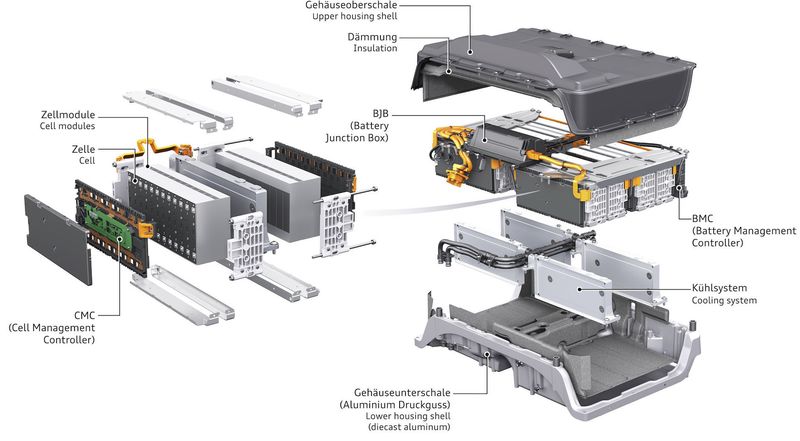
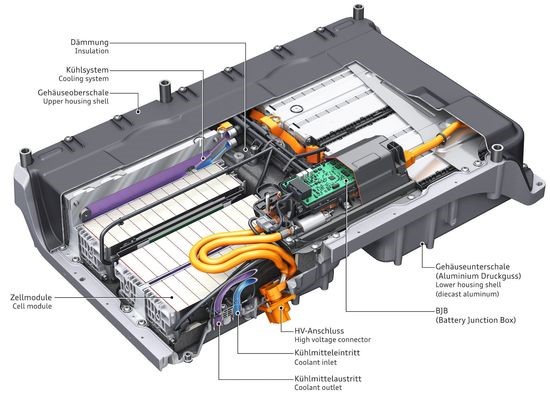
Battery design.
A high voltage battery has an ideal operating temperature of around 25˚C (77˚F). Therefore, it has a liquid cooling system in which four cooling plates regulate the temperature of the eight modules. Cooling is provided by a separate, flexibly controllable low-temperature circuit that also includes power electronics and a charger if necessary. The Audi A3 Sportback e-tron can also generally be driven purely on electricity in the heat of midsummer and cold winter temperatures.
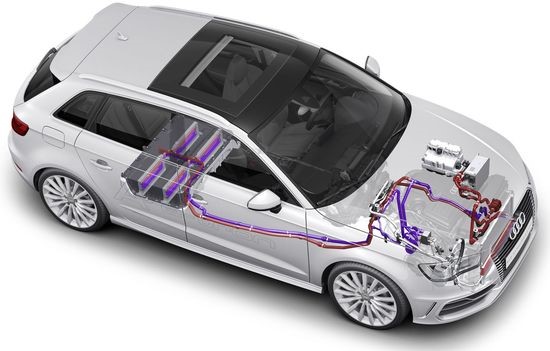
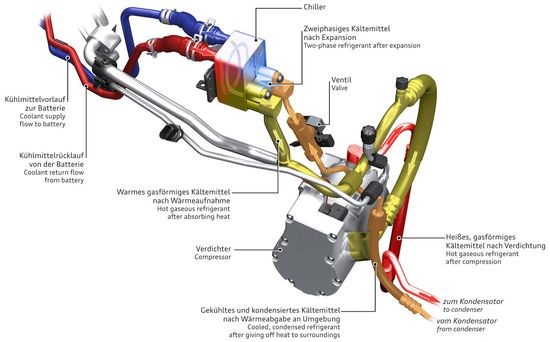
Top: Battery cooling circuit. Below: a detail on a refrigerating machine.
Mounted under the rear seat, the flat battery is extremely well protected in an area where the high-strength and ultra-high-strength steel components of the passenger cell form a particularly strong structure. The body is attached to the floor of the car at five points. In the event of a crash severe enough to deploy the belt tensioners or airbags, the system is disconnected from the power source.
A 12-volt battery for low-voltage consumers and a 40-liter (10.6 US gal) fuel tank are located above the rear axle. The luggage compartment remains spacious. It has a capacity of 280 liters (9.9 cu ft) as standard and 1,120 liters (39.6 cu ft) with the rear seat back folded.
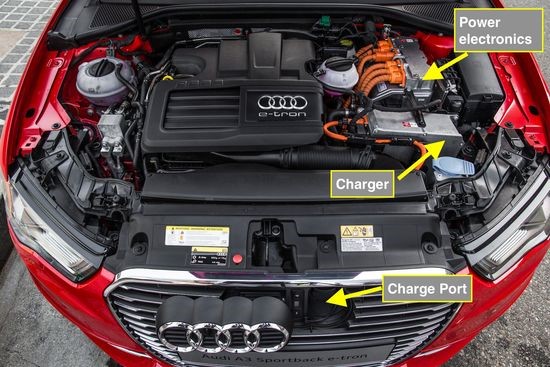
With a volume of only eight liters (0.3 cubic feet) and a weight of only ten kilograms (22.0 pounds), the power electronics in the engine compartment, which includes a DC/DC converter for connection to the 12-volt electrical system, are compact and lightweight. Six high-performance transistors convert the direct current supplied from the battery into three-phase current for the electric motor.
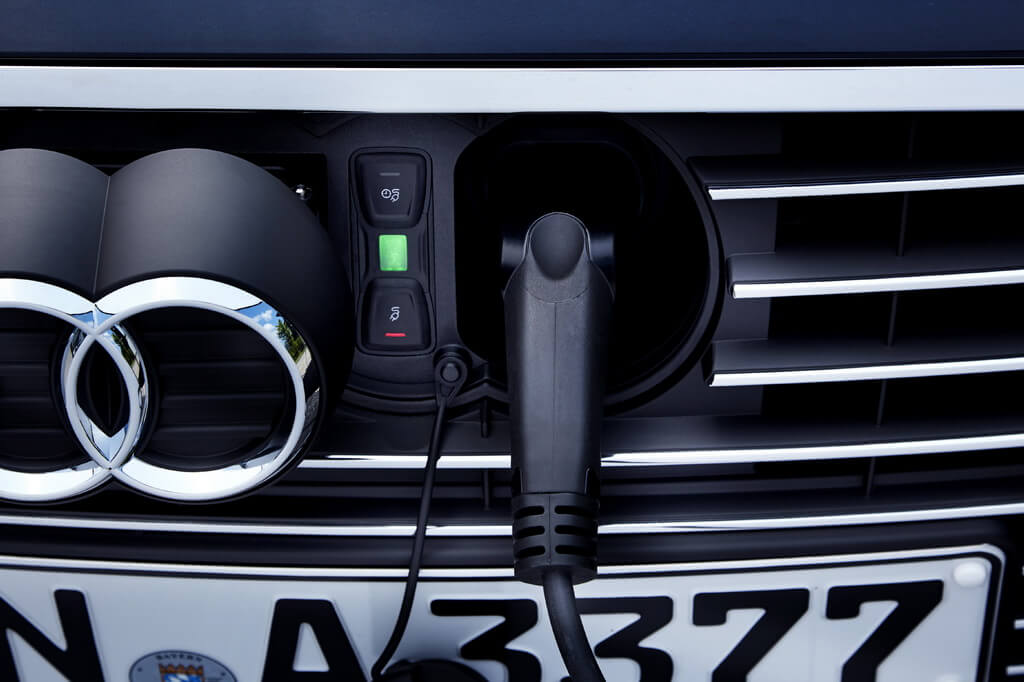
When charging the A3 Sportback e-tron, the charger converts the incoming alternating current into direct current for the battery. The charging port is located in the Singleframe grill behind four rings that fold to the side. In addition to the status indicator, there are also two buttons here. The driver uses them to start the charging process immediately or with a timer for the next trip. Timer charging can also be programmed using a special menu in MMI navigation plus or the new Audi connect e-tron services.
The Audi A3 Sportback e-tron comes standard with a charging system consisting of a control unit with graphic display and a portable car charger with two power cables with 120 V and 240 V sockets. For home use, the e-tron charging cable can be mounted in a wall box (standard with the e-tron plus package) - lock your device in place and access Level 2 charging. The charging dock can be locked to protect your equipment from theft, and a PIN code provides added security.
A 240-volt charge recharges the battery in about 2 hours and 15 minutes; charging through a 120 volt outlet takes approximately 8 hours. Installation of a 240-volt home outlet and a home charging station are optional.
An available A3 e-tron smartphone app allows drivers to remotely check the status of their A3 e-tron. It can be used to check the battery status and to "charge schedule" - setting a time to automatically start charging. The driver can also use the app to remotely adjust the climate control for added comfort and energy savings.
Audi's energetic offer . To make driving the A3 Sportback e-tron comfortable and environmentally friendly, Audi provides the Audi Energy product portfolio for every vehicle sold. Audi Energy includes:
- A standard mobile charging system developed by Audi that works with standard US outlets or 240-volt service;
- Ability to have a professional 240-volt outlet installed through Bosch Automotive Service Solutions, which can reduce home charging times to approximately 2.25 hours;
- Additional discounted solar installation through SunPower; and
- Audi contributes to environmental programs through 3Degrees to help offset the carbon emissions of every A3 Sportback e-tron sold.
Drive modes . The A3 Sportback e-tron offers four driving modes:
- Electric car mode, in which the car is powered only by the electric motor for a smooth and quiet ride with fast acceleration. This is the default startup mode, regardless of what mode might have been running at the last shutdown.
- Hybrid mode usually allows the car to choose the most efficient power source — electric, hybrid, or gasoline.
- The Hold Battery mode enables hybrid driving, preserving the electric vehicle's range for later use.
- Battery charging mode uses the gasoline engine to recharge the battery while driving at highway speeds. The electric motor can also supplement the gas engine to provide an additional power boost if desired.
In driving the A3 in combination with high-speed interstate cruising; very low speed from bumper to bumper. and congested city driving, we generally defaulted to EV mode in the city, and also used EV mode on the interstate until the state of charge began to drop to the bottom of the power meter's charge indicator dial. At that point, the quick switch to battery charging mode worked well enough to bring the SOC up to a point where it was comfortable to use for the next city segment, while still maintaining the performance sometimes needed on the highway.
Screenshot from the MMI showing some of the available e-tron stats: 58% of this drive segment was done in electric mode. Click to enlarge.
The driver can also use Audi drive select to adjust the character of the car according to the comfort, auto, dynamic and individual modes. The system, which is included as standard, also controls the additional components of adaptive cruise control and adaptive lighting.
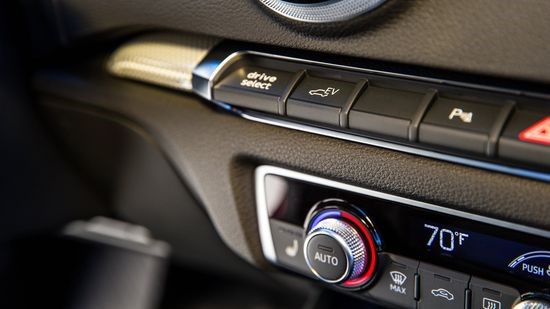
The leftmost button, “drive select”, allows drivers to click through the Audi drive select settings of their choice; in turn, you can navigate through the electronically enhanced MMI screen on the central dashboard console. The "EV" button next to it allows the driver to select four driving modes. The selection is displayed on the information screen in the center of the instrument panel, as well as on the MMI screen. In addition, drivers can use the MMI steering wheel to make selections on the MMI screen. Pragmatically, however, we've found the push-button method to be much faster, easier and safer, i.e. looking at the road. Click to enlarge.
Connected and secure technologies . The A3 Sportback e-tron features both e-tron-specific technology and general Audi features.
The MMI operating system has an electronically enhanced screen, the terminal is located on the console of the central dashboard. The available touchpad is integrated into the rotary MMI control wheel, which provides intuitive and simple control. The touch panel supports character recognition for some applications, for example for entering the PIN code to log in to Audi connect. It is much easier to quickly trace a number on the panel than to select it.
The available MMI navigation plus system is equipped with 4G LTE-based technology, MMI touch and two SD card slots for MP3 files.
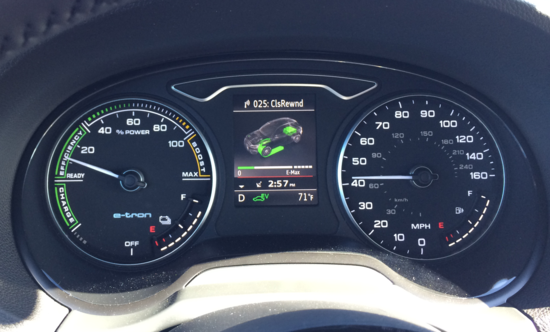
A close-up of the instrument cluster in operation. The power indicator on the left shows the total system power and battery charge status.
A green "EV" icon at the bottom of the info screen indicates that the vehicle is in EV mode.
The meter on the right shows the speed and fuel level. Click to enlarge.
The NVIDIA graphics processing unit (GPU) generates complex 3D images used in all online, voice control, media navigation and phone functions.
Audi connect is the label for online services for the A3 Sportback e-tron that allow drivers to control and adjust numerous functions. For this, Audi has developed an application with informative graphics that works on modern iOS and Android smartphones. Audi also offers a dedicated web portal for, among other things, registration and activation of services (www.a3etron.audi.com).
Audi connect e-tron services allow drivers to remotely check the vehicle's status, such as battery charge and range, as well as receive various service information and the vehicle's location. Drivers can also remotely control charge scheduling. They have the option to start and stop charging or set a timer to indicate when they next plan to drive. They specify in detail what time and on what days they want to leave with a fully charged battery.
The climate control scheduling function is used to activate the air conditioner or optional booster heater on a timed basis or according to a timer schedule. In the last case, which is called pre-climate, the car takes the necessary energy from the outlet so as not to violate the electrical range.
Owners can view a variety of driving data, such as average power consumption or average speed, on the web portal or mobile app.
MMI navigation plus uses 4G LTE to provide the driver with personalized Audi Connect services, from navigation with Google Earth and Google Street View.
Assistance to the driver . The Audi A3 Sportback e-tron offers several advanced technological features, including:
- The standard Audi pre sense system, which helps detect when an emergency maneuver is in progress and prepares the vehicle and passenger restraint systems for a possible collision.
- Audi Side Assist is available, including Lane Change Assist, which operates at speeds above 29 mph and provides visual warnings located in the exterior mirror housings.
- Standard electronic cruise control with coast, recovery and acceleration functions.
- Audi's adaptive cruise control with stop-and-go function is available.
- The Audi active lane assist system is available: when the system detects that the driver is leaving the lane without signaling, the car will gently adjust the steering wheel to help the driver stay in the lane.
- Audi pre sense front: includes brake assist or partial braking when a risk of collision is detected.
Subjective impressions . The A3 Sportback e-tron is an extremely attractive entry into the burgeoning US plug-in hybrid market. The A3 e-tron is very comfortable and fun to drive, especially given its power, handling and smooth ride. Its cargo space and split-folding rear seats enhance its overall utility.
It's a great electric car when it's in electric mode, and a stunning hybrid when it's in that mode. The engine, one of the smaller displacement engines currently used in PHEVs, never sounds like it's straining, even when kicked down for some aggressive passes in hybrid mode, for example.
The Audi MMI system continues to develop and mature as developers improve the core functionality as well as the various human-machine interfaces.
Even the price seems somewhat appropriate. U.S. pricing for the 2016 A3 Sportback e-tron will start at $37,900 for the Premium package and rise to $46,800 for the top-of-the-line Prestige package. Buyer customers may qualify for applicable state and federal incentives and tax credits (such as a $4,168 federal tax credit). In California, for example, that would likely be $33,157 for the entry-level model, Brabeck noted in his presentation.
By comparison, the 2016 A3 family starts at $29,900 with the A3 1.8T, rising to $35,600 as a convertible. The A3 2.0T starts at $32,900, while the Cabriolet starts at $38,600. The base A3 TDI starts at $33,200, while the range-topping S3 starts at $41,400.
The A3 e-tron beats all of these models in terms of fuel economy and emissions, and performs as well or better than half of them.
A quibble that some may have with the entry may be the decision regarding the size of the package and the resulting volume of an all-electric range. Driving in EV mode in the A3 e-tron is great — so great, in fact, that it's a little frustrating when you're driving down the highway and realize you need to switch to hybrid mode because the battery has died. (Or, if you're not paying that much attention, the system switches for you.)
However, with a few notable exceptions — high (Volt) and low (Prius PHV) — this mid-range package is the focus of many new plug-in hybrids, likely due to a combination of efforts to keep cost down and weight manageable. While the battery charging mode option isn't an ideal solution, it's a practical workaround that extends the range of EVs without using an outlet.
This initial electrified entry from Audi in the US is strong; The obvious care taken with the systems and engine software also makes us eager to see what Audi's next electrified offering, PHEV or pure EV, will bring.
A few more photos ;-)
 The original is here