Advanced ADAS driver assistance systems

AvtoAd
31/05/2022
Advanced driver assistance systems are key factors in the development of autonomous vehicles of the future. Already today, ADAS technology provides a high level of driving comfort and accident avoidance with features such as adaptive cruise control and emergency braking assistance.
ADAS sensors and computer equipment for 360 ° perception
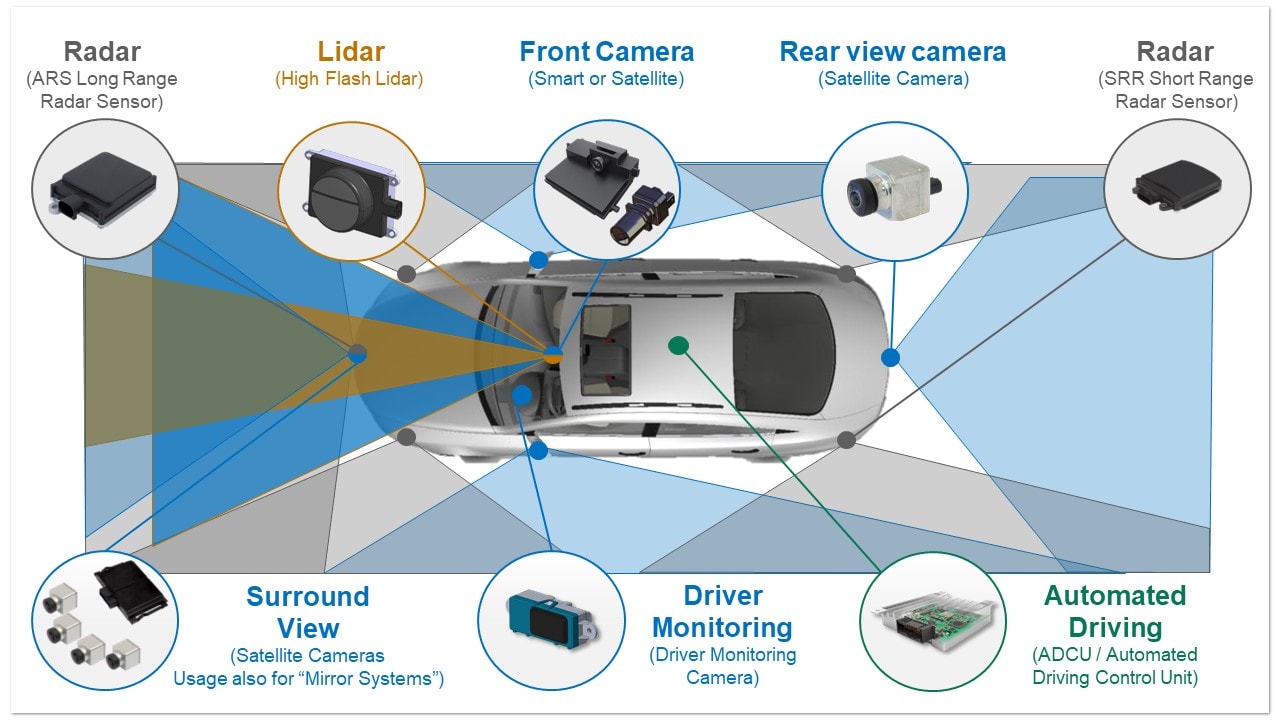
Radar, camera and Lidar technologies provide an extremely reliable 360 ° view of the car, which is a prerequisite for the implementation of advanced driving functions. CES has access to the latest portfolio of sensors for integration into your car:
- Long-range radars, for example, for functions such as emergency braking and adaptive cruise control.
- Short-range radars, for example, for functions such as blind spot detection, rear cross-traffic notification and lane change support.
- Front cameras, for example, for lane keeping and speed limit functions.
- Driver monitoring cameras, for example, to monitor driver availability.
- Satellite cameras, for example, for 3D viewing and mirror replacement.
- Automated driving control units to accommodate functions that require a comprehensive connection of sensors, such as Traffic-Jam-Assist, Highway Assist and extended arms - disabled functions.
ADAS functions for safety and comfort
Based on the available sensor settings, ADAS functions contribute to road safety and relieve the driver of tedious driving tasks. CES offers turnkey integration of state-of-the-art ADAS features into your car, including:
Adaptive cruise control
The ACC system works like a normal cruise control system in open lane conditions. When approaching a slower vehicle on the route of the object, the ACC system uses the power unit and electronic brake system to regulate the speed of the subject, as well as to maintain the movement selected by the driver. Including:
- ACC Stop & Go;
- Reaction to static Auto Go objects;
- External speed support input.
Helper in traffic jams
The congestion assistant combines an adaptive cruise control system at full speed with Auto-Go capability together with a lane keeping system at full speed. The route can also be determined by the trajectory in front of the vehicle in certain circumstances, such as low speed, heavy traffic, and lack of lane markings. The extended version of the system will also be able to help the driver on construction sites with reduced side space.
Detection of blind spots
The Blind Spot Detection System (BSD) monitors the blind spot area and removes much of the load from the driver. This works to avoid dangerous situations. The sensors monitor the road behind and next to your vehicle about the exit in the absence of a gap.
Cross-traffic warning

The Rear Crosswalk Notification System (RCTA) uses the same radar infrastructure to detect vehicles in a blind spot (blind spot detection, BSD) and can help avoid accidents when leaving and parking in reverse. Because it often ends in serious accidents with injuries.
Auxiliary traffic light and speed limitation system

The device ensures that the current speed limit and other road signs are displayed to the driver on a regular basis. There is an automatic recognition due to the connection between the images taken by the camera and the speed limit information stored in the navigation system. In this way, the driver will be shown even speed limits that are difficult to catch visually. The function includes detection of conditional speed limits by means of additional reading of optical symbols. If desired, the SLA can be extended to Intelligent Speed Assistance (ISA) by adapting cruise control to speed limit information with road sign recognition.
Auxiliary lane keeping systems

The auxiliary restraint system keeps the vehicle in the center of the lane within the full speed range. The system aims to increase comfort by supporting the driver in lateral control tasks. The device requires the driver to keep his hands behind the wheel. The LKA system can be combined with Adaptive Cruise Control (ACC) to support both longitudinal and lumbar control. The system can be easily turned off at any time.
Circular viewing camera

The roundabout camera was originally designed to give the driver new and previously inaccessible viewpoints of his car, usually using 4 cameras and a computer. These views benefit the driver in several scenarios; starting with checking the blind spot when changing lanes on the highway and ending with the exit from the parallel parking lot without grinding the wheels.
ADAS on the road to automated driving
As a result of the transition from highly automated but still driver-controlled to partially autonomous driving, important technological barriers have emerged. These barriers need to be overcome. CES provides all the necessary products and services to facilitate this. Example:
- Sensor fusion and environmental modeling;
- Test equipment for autonomous driving;
- Powerful safety computing units (ADCU) for autonomous driving.
Source .