5 valves and 8 levers. If we talk about the A4, A6, Allroad, A8 and A3 families after 1996

AvtoAd
11/11/2022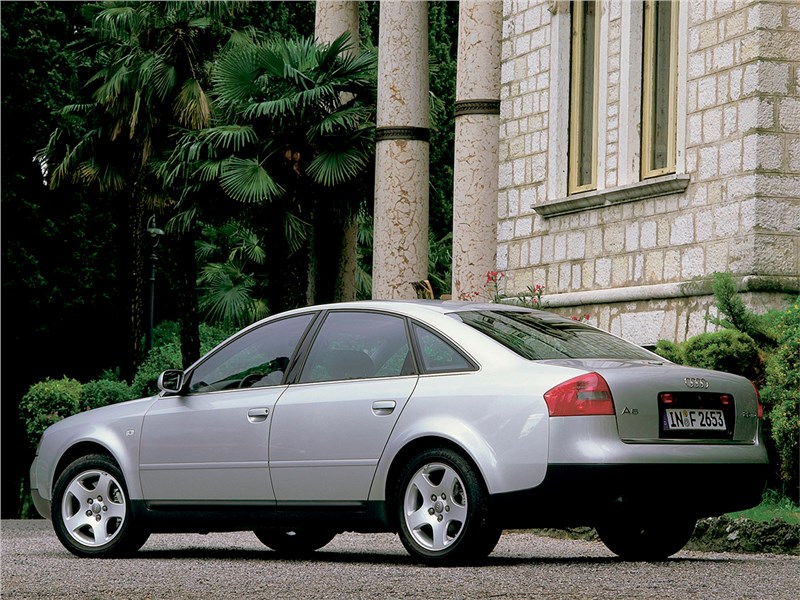
"Progress did not stand still, and sworn friends-competitors did not sleep. Turnips were actively picked in Ingolstadt ... »
Actually, the weak points of Audi have been known for a long time. Longitudinal heavy engine, simple MacPherson strut in front - as a result, the driving characteristics are not good, even if it is reliable and easy to maintain, but on a rally or a ring with such a combination, in today's times, you will not get away, and the magazine guys - no, no , So they point a finger, it's a pity ... Again, the interior of the 80s is outdated, the front rack is poorly located and cramped. This is where the insidious plans to eat all the competitors at once ripened in the heads of Ingolstadt, since the experience of the 80s is already there.
First, they made a multi-link front suspension, tested it on the A8, the press and buyers were delighted. Reducing unsprung masses, the levers were made of aluminum alloy, then the rotary fist will also become aluminum. They started working on the engines - there were already 2 valves per cylinder, 4 too, yes, but we will make 5! And they did, and they also changed the phases to atmospheric motors (they are turbo without special need, but then they also had a "phase shifter"). Both V6 (ACK - 2.8 - 193 hp) and 4-cylinder 1.8 were made in parallel, since the engine is old and has been used for a long time. ADR came out, as much as 125 hp. For connoisseurs, it was slightly inflated, not so much for the sake of power, but for the sake of even characteristics. Well, when everything turns out so successfully - and we will change the interior and the body, well, it must have worked out, compared to the 80s. It remains to arrange everything - and A4 is ready. And having A4 and A8, it was very easy to make A6, and B5 Passat too. By introducing an air suspension into the A6 and slightly "hanging" it with various pseudo-rails, we will get an Allroad. Perhaps this is not a very correct statement, but in my opinion, VAG released many modifications of the same machine, although such unification is, in principle, quite convenient from the point of view of maintenance. We can talk about the A4, A6, Allroad, A8 and A3-Golf families and other Octavias.
Some malicious ones, however, grumbled that, they say, the timing belt in ADR somehow often cuts and a lot of valves rot at the same time, and sometimes the piston torn off by the valve plate breaks at the same time. We took into account the wishes of Audi, made a new kit for the timing belt - a belt with 153 teeth and a more reliable tensioner. Yes, there was a reserve insurance: although the 1.6 engines were modernized, they did not essentially leave the "old days". The same 2 valves per cylinder, everything is simple, without fancy, well, except that the intake manifold is plastic and of variable length. The suspension on the first series did not work for long at all, something with the levers did not work out, now, however, it is better, they fixed it. At first, the electricity and electronics didn't turn out very well in places either, but they corrected, replaced, reworked - it seems to have become decent. Well, later on, the people more or less got used to the car, and the services somehow got used to it, although, as always, far from everyone.
Content
1. Motors and power\ignition system.
2. "New" version of the tensioner, the same is used on the V6.
3. Suspension.
Motors and power\ignition system
"Iron" part of the motor 4ts. as always in Audi - at a height, there are no problems with either the crankshaft or the pistons. The valves have a 6mm rod, and, accordingly, their springs are quite "weak". In normal operation, this does not lead to any negative consequences, but there are known cases of refueling with gasoline with an increased content of resins, which led to valves sticking on soot with subsequent death. The cases are not massive, but they have taken place.
The density of the cylinder head arrangement required a reduction in the dimensions of the g/compensators, they are of a new type (incompatible with the previously used ones) and different for the intake and exhaust valves.
Normal access to the timing drive is only after removing the "muzzle" or at least "pushing" it, although it is removed quite easily in all "new" ones. VAG recommends removing the "muzzle" completely, it is almost enough to move it forward a little, although there are fans of replacing the belt even without dismantling it.
The drive itself (4ts-20V), as mentioned above, can be of "old" and "new" type. If there is an old one, it is better to switch to a new one, it is much more reliable, and it is supplied both with a VAG and a non-original set (belt + tensioner + roller). Although the "new" version has already been installed on almost all motors in the "old" versions in the process of replacing the belt. It is easy to determine which version is on the motor by the appearance of the tensioner - the old version is of the pulling type, the new version is "pushing".
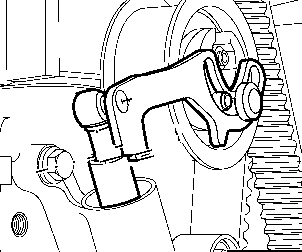
"Old" version of the tensioner
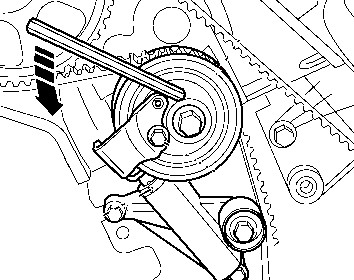
"New" version of the tensioner, similar to the one used on the V6.
To old age, the chain is stretched and its hydraulic tensioner may fail, a characteristic rumble appears in the cylinder head, relevant for both 4ts and V6-30V.
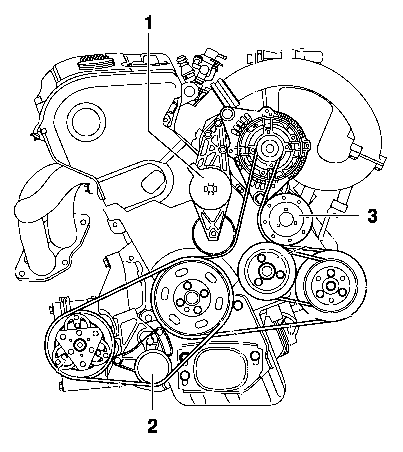
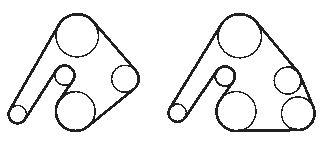
Addition reason aggregates in 4t. - as many as three belts, if there is an air conditioner. You should pay attention to the tensioner of the multi-arm belt (1), it may begin to fall apart when old, which leads to skewing of the roller and, as a result, to slipping of the belt, the roller itself may also "make noise". Also the weak tension roller of the compressor belt (2) and the visco clutch bearing (3). The V6-30V has a traditional poly-V belt for all attachments, similarly, the tensioner and its roller require attention during maintenance.
Among the common troubles of the motor control system, it should be noted the loss of idling speed (XX) and other related "glitches", such as poor start-up, associated with the initialization of the valve. The initialization operation is carried out using VAG 155152, while the damper may not respond, in which case it should be washed, but if this does not help, it will have to be changed. The installation may take off when the battery is discharged or replaced. It is also possible for the flow meter to fail, but strangely enough, with a functioning damper, the motor works quite normally.
Also, in cold weather, the engine may not start the first time, this is due to the "environmental" start-up program.
Of course, all standard defects are also possible: failure of the lambda probe, candles, T sensor, Hall sensor, sometimes ignition coils, various destruction of air hoses, most often crankcase ventilation, etc. Among the defects that "stop" the car, it is worth noting the failure of the motor speed sensor (G28), with its phenomenal reliability, as in the old versions, the VAG decisively ended, and traditionally - the gas pump. This can also include the failure of the instrument panel and the immobilizer built into it. In this case, you will have to pay a visit to the "officials", only they can prescribe an immobilizer. However, this does not prevent you from ordering components in a "cheap" place, especially since the panel is usually "restored" (X-rated) and you can hand in the old one, thereby saving a lot. In general, there are quite a lot of x-parts (pumps, flow meters, etc.) and their price difference with new ones is many times.
The turbo version (AEV) is essentially a somewhat simplified "iron" part of ADR (there is no phase corrector) with the addition of the necessary and familiar equipment for R5 turbos. That is, this motor is usually sensitive to air hose and bypass leaks. But the resource of the turbine has significantly decreased compared to its predecessors, it received a built-in wastegate (the valve is located directly in the housing), and it has greatly decreased in size. The appearance of rumbling in the area of the turbine usually means that the valve has already started to hang and the replacement of the turbine is "just around the corner". The market quickly responded to the mass demand for turbines, and nowadays you can easily get a refurbished turbine or a new one in a non-original design (or rather, it is the same KKK as the original, but in its box and without "rings") at prices for new turbines about 50-60% of the cost of the original. The resource of the turbine (both 1.8 t and 2.7 t) strongly depends on the driving style, it is obvious that it is significantly less for racers. The normal resource is considered to be 150 tkm. In addition, an unsuccessfully laid turbine oil supply line (which ends with a hose in the armor) has a tendency to coke, which eventually leads to oil starvation of the turbine before its rapid failure. In the process, VAG modified the heat protection of this hose and the severity of the problem decreased significantly. Nevertheless, in a car with high mileage or age, the hose itself should be checked on occasion. In the future, the motor will be modernized, in addition, it is very fond of tuning both by VAG itself and by many third-party companies, therefore there are many versions of 1.8T with different power.
On the wave of unification, V6-30V engines were also created. The "old" V6 (basic AAN) received a cylinder head with 5V, hydraulic tensioners, etc., that is, in fact, the V6 cylinder head is a modification of the ADR ones. The V6-30V piston, as in AAN, is lightweight, with thin rings and "short" pistons, so increased oil consumption is practically the norm for them. Also, taking into account the workload of the motors, they are very critical of the quality of the oil and are not inclined to "forgive" its low quality or a long replacement interval, unlike the old 4 and 5 c. motors of the 80s. Power systems across the entire range of motors were also unified, and the dissimilarity of the 4A body, when each motor had "its own" power system, was done away with. On the one hand, the "conversion" of the systems looks frightening, but all of them, taking into account the uniformity, are relatively easy to repair, if the following conditions are met - the presence of VAG1552 and documentation. The old methods of ringing circuits and sensors for these systems are largely obsolete and can lead to problems under certain conditions. The unification of both the electronic part and the motors themselves led to a certain "standardization" of defects, which is very good from the point of view of repair. Of the mass defects, in addition to the damper, it is worth paying attention to the condition of various small hoses and tubes, even with relatively small runs, they begin to crack and fall apart, which leads to a significant deterioration in the operation of the motor, while VAG diagnostics can only confuse, because the computer perceives these air suctions completely inadequately. Also, the standard defects include the failure of the flow meter, while VAG diagnostics can also be wrong.
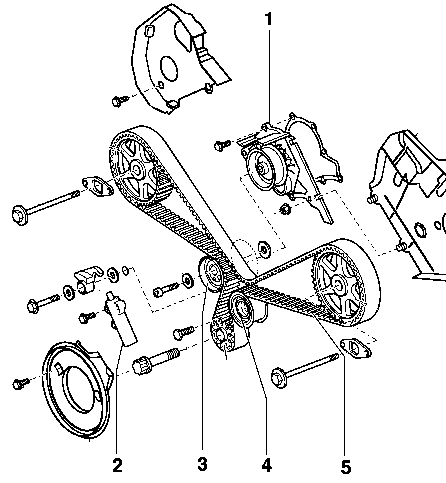
The timing drive in the V6-30V is similar to the old versions and differs only in the automatic tensioner (2), although of course it has its own belt-rollers (3,4,5). As always, when replacing the timing belt, the pump (1) and rollers are changed. Also, taking into account the time-consuming dismantling of the "muzzle", you need to be ready, if necessary, to replace the thermostat, poly-V belt and its roller or tensioner assembly. Also, there is wear and tear of the visco-coupling bearing - the part is quite expensive and available only in the original version, there are certain tricks when disassembling the visco-coupling and its bearing with the housing. Rokit in the cylinder head usually indicates the end of chain tensioners, replacing them is a troublesome and expensive matter. Various oil "heats" are usually also provoked by the design, aluminum-cast iron pairs, metal gaskets tend to lose their tightness during sharp temperature changes characteristic of the Russian Federation. Similarly, there is a failure of valve covers.
The cooling system of all engines of the "large" family has a visco clutch, the electric fan is assigned the role of an additional one. There is a radiator in the front, in our conditions, it usually does not live very long, given the winter cold and road cocktail. In 4ts, the coolant nozzles on the motor are usually plastic and like to flow. With a "snout" all this "management" (and the intercooler in diesels) is easily damaged, since the front plastic panel is hard and not far from the engine. It is also worth paying attention to the T sensor for "brains" (likes to "lose" the har-ku) and its retainer, unlike the early versions, it is plastic and when replacing the sensor it is better to stock up on a new one, the old ones often break.
V6-30V-biturbo and V8-4.2l became an alternative to the discontinued R5-20V-turbo. At the same time, the 2.7t turned out to be not very reliable, it is far from the R5T in this regard. In general, 2.7T is a V6-30V of reduced volume and slightly modernized on the block (there was not enough stiffness, sacrifices were made) plus turbo weighting. As a result, the motor has become very complicated and is characterized by disgusting access, even for medium repairs. And of course, components cost a lot. Let's say such a measure as replacing turbines, even if you use a non-original one, is very expensive and in garage conditions, to put it mildly, difficult. As a result, V8-4.2 was made the main S-motor. It was thoroughly redesigned and successfully unified with the V6, but it is worth noting that the V8 block is traditionally aluminum, so any damage to the CPG turns into a serious problem for it, the repair of such a block requires its own technology, and traditional boring-replacement of rings is meaningless for it. Usually, in such cases, the block is sheathed and the car is urgently sold, and all the consequences of this measure go to the new owner. Of course, you can order the block assembled, but the price and a certain problem with the documents do not contribute to the mass of such a solution.
Diesels have also gained some popularity, the most common V6-2.5l. This engine will be discussed in a separate article (while being prepared).
Pendant
The unreliability of the suspension of the models of the first years of production (initially, it produced only 20-30 tkm) gave birth to a legend that still lives today, about the low reliability of the VAG multi-lever suspension. However, everything is not so bad. In the first, VAG changed and modified the levers, achieving quite tolerable "walkability" in Russian conditions (about 100 tkm. for the original), in the second VAG supplies complete sets of levers (8 levers + 2 tips + fasteners) at a relatively low price (the average set of about 15,000-17,000 rubles). It is worth paying attention that the stabilizer bones are not included in the kit, if necessary, they must be purchased separately. Also, a significant factor is the price of levers "by piece", in fact it is twice as high as in a set. An obvious conclusion follows from the above - having purchased an Audi or PV with a multi-lever suspension, it makes sense to take your time to purchase a set of levers at the minimum price and put it in stock. Accordingly, if it is necessary to replace part of the levers, they can be taken if necessary from this set, without overpaying for each lever that is purchased separately. Kits for A8 are different from standard ones (A8 has a different configuration of one of the levers). In Allroad, the situation is similar, but there are no kits for it, but it is still cheaper to take a standard kit and add two "allroad" levers to it, than to take them individually.
An interesting observation - the "legend about levers" has led to the fact that, upon a complaint about the slightest knock in the suspension, most services immediately offer (and change!) a set of levers, although it is often not their fault. It also happens the other way around, instead of replacing part or all of the levers, they can change the rail, etc. Therefore, it is worth paying attention to the sources of knocks in the suspension - these are the levers themselves, the ball bearings may also start to squeak, usually this is the "beginning of the end", but you can get rid of the squeak for a while by lubricating the ball bearings with transmission oil (provided that they are still in normal condition). Stabilizer bones, tips, steering rods (ball joint) can knock, and shock absorbers give a deafening knock with a sufficiently large mileage.
As always, the levers and their sets do everything for those who are not lazy from the manufacturing companies. However, you should not save money - high quality is traditionally provided only by Lemforder, which is the same original. Unfortunately, other manufacturers are inferior to the original to a greater or lesser extent, and given the rather high labor cost of replacing the levers, the point of installing cheap replacements is practically reduced to zero.
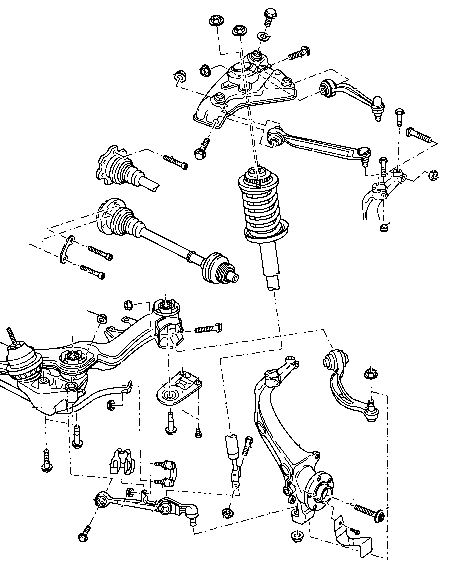
It is obvious that the levers are loaded differently and, accordingly, do not fail at the same time. If it still makes sense to change the lower levers individually (replacing one is in no way related to replacing the other), then it is better to change the upper ones in pairs, especially since to replace them, you have to remove the entire rack with the support. On average, if more than half of the levers are worn, it makes sense to replace the entire set and not return to this issue for a long time. As a rule, tips go longer than levers. The steering rod (ball joint) may also fail or its anther may break. The bones of the stabilizer in the early version were with ball joints, then changed to significantly more reliable silent blocks.
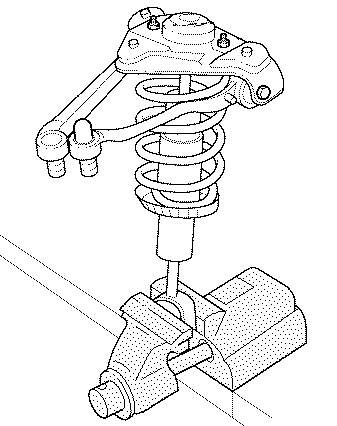
The original shock absorbers are usually supplied by Boge, and they are usually used as a substitute. The ease of replacing front ammo (as in 43, 44 and 4A bodies) is a thing of the past, now you need to dismantle the rack and tighten the rigid springs.
A large number of A6s from Europe have more or less lowered suspension, which in our conditions is usually a disadvantage. To solve this problem, you need to install a set of springs from a reinforced suspension, sometimes it is also called a "Russian package". The rear suspensions themselves, in fact, differ little from their predecessors. With monodrives, it is possible for the rear bogie to fail, the A4-quattro suspension is almost identical to the 80 quattro B4, the A8-quattro has a somewhat "sophisticated" suspension, but, apparently, in addition to the increased complexity of the repair (let's say - in garage conditions, it is quite difficult to repair it , unlike 4A-44), there are few differences from the ancestors, despite the different construction
Also, some A6s have rear air suspension, which is not very reliable in our conditions. If air cylinders lose their tightness (and they are not cheap), you can install standard rear struts, and disable the ground clearance stabilization system. But for the Allroad, this option is excluded - it simply does not have a normal suspension. As practice shows, for most used Allroads that arrived from Europe and America, the front air cylinders need to be replaced rather quickly. The first "call" that warns of a quick replacement of cylinders - the lowering of any side when parking, is a signal of the presence of a mini-crack in the cylinder and it will progress quickly. The "explosion" of the balloon is much less common, in this case the car "falls" to the minimum level (front or rear), but retains the ability to move, albeit slowly (30-40 km/h). The replacement process itself is relatively simple, but requires attention and accuracy, otherwise there may be problems with the tightness of the system. Also, after replacing the cylinders, it is useful to adapt the suspension. Common system defects also include pump failure.
A hydraulic ground clearance stabilization system similar to the one used as far back as the 44th body was used on some early versions of the A8. Accordingly, the main defect of the system is similar - the leakage of an expensive shock absorber from hydraulic pumping. But progress has made its corrections, and the A8 may have a second defect that its predecessors did not have - the fluid supply tubes in the ammo are very thin and can simply be eaten away by corrosion with age. Of course, if desired, this system can also be dismantled and a standard suspension installed.
The braking system has remained traditional and differs little from 4A, except that ABS has become better and communicates more with VAG1552, but the first versions of this ABS are characterized by low reliability and often require replacement or repair (the latter is not always effective). The system of hydraulic brake booster, which was used earlier on esks and even earlier on 44s, has become a thing of the past, everyone now has a vacuum cleaner. In heavy and powerful models, a 4-pad caliper + large (314-323 mm) brake discs is widely used, then the caliper will be replaced with a 2-pad caliper. The Allroad has a certain problem - the front brake discs bend quite quickly and begin to "beat", and this happens even in new cars. The nature of this strange phenomenon has not yet been fully studied and remains on the conscience of VAG, but the result is obvious - often with the replacement of the front pads, the discs are changed.
Conclusion
Analyzing existing modern car designs in a complex, a strange feeling arises - as if everything is in place and progress - obviously, because no one will deny that multi-lever suspensions are better in terms of characteristics than the same McPherson, multi-valve heads are better than 2-valve ones, variable gas distribution phases are better than constant ones, etc. Of course, all this was invented in the first half of the 20th century, but the time of mass application has come only now. It is also obvious that the effect of the application of all these technical inventions thanks to computer control has become even greater and, what is important, the cost of production has decreased, which made it possible to apply all this so widely.
But there is also the reverse side of the coin - the same progress of computers plus the general progress of technical development has led to the fact that designers can more or less accurately lay down the resource of units and avoid excessive safety margin even at the design stage. This leads, on the one hand, to a reduction in the cost of production, which is so important under conditions of fierce competition, but on the other hand, the system is deprived of a reserve, which reduces its reliability. At the same time, rigidly setting operating conditions reduces the degrees of freedom of the system, which also reduces its stability (reliability). It is also obvious that the increase in the number of system components (in levers, valves, various systems, etc.) also does not have the best effect on reliability
Thus, modern cars have a limited resource and extensive repairs are meaningless for economic reasons, and current repairs are expensive. There is no need to go far for examples - a hydraulic tensioner with valve timing adjustment on the one hand has a positive effect on powerful performance and its economy, but on the other hand, in the event of its failure, all the savings achieved will be more than "eaten up" by the price of the tensioner and its cost installation. The same levers, despite their relatively high "travel", however, in the case of replacement, will cost significantly more than McPherson's, if only for the simple reason that there are much more of them. A huge amount of electronics, in addition to general problems, gives such a negative factor as the need for documentation, and a detailed one, and the necessary defect must be found in it. Although it seems that sobering up is beginning - various marketing studies are being conducted, which clearly indicate the needlessness or lack of demand for many systems and "frills", which are stuffed with modern cars and car manufacturers are beginning to pay attention to this.