The temperature of the piston and cylinder is an important parameter for operational safety
and service life. The peak temperatures of the exhaust gas, even if present only for a short
time, can reach levels in excess of 2,200°C. The exhaust gas temperatures range between
600 to 850°C for diesel engines, and 800 to 1,050°C for gasoline engines.
The temperature of the fresh intake mixture (air or mixture) can be in excess of 200°C
for turbocharged engines. Charge air cooling reduces this temperature level to 40–60°C,
which in turn lowers the component temperatures and improves filling of the combustion
chamber.
Due to their thermal inertia, the piston and the other parts in the combustion chamber do not
exactly follow these temperature fluctuations. The amplitude of the temperature fluctuations
is only a few °C at the piston surface, and drops off rapidly toward the interior. The piston
crown, which is exposed to the hot combustion gases, absorbs different amounts of heat,
depending on the operating point (rpm, torque).
For non-oil-cooled pistons, the heat is primarily conducted to the cylinder wall by the compression ring, and to a much lesser degree,
by the piston skirt. For cooled pistons, in contrast, the engine oil carries off a large portion of
the accumulating heat; Chapter 7.2.
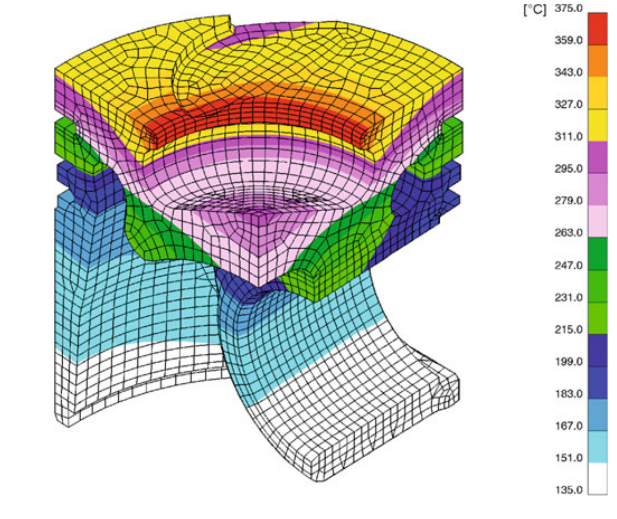
Heat flows that lead to characteristic temperature fields result from the material cross sections that are determined by the design. Typical temperature distributions for gasoline and
diesel engine pistons are shown in Figures
Temperature distribution in a gasoline engine piston
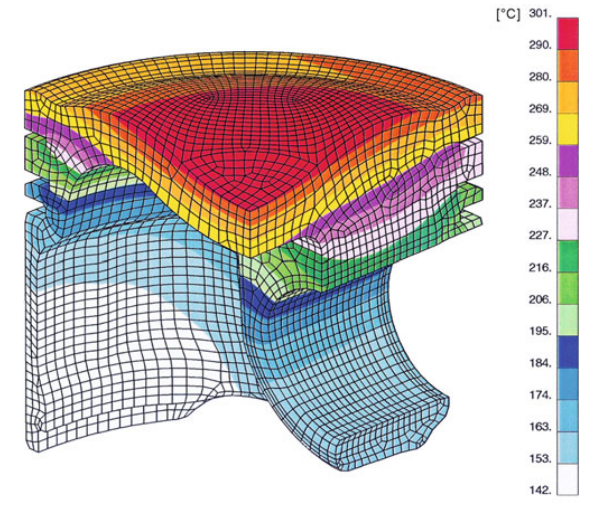
Temperature distribution in a diesel engine piston with cooling channel