How to troubleshoot HALDEX 4th generation

AvtoAd
29/09/2022
HALDEX Generation 4 Troubleshooting Guide
Eligible vehicles are usually after 2008:
- Audi TT, TTS, TTRS, A3, S3.
- Seat Altea.
- Skoda Yeti, Super.
- VW Golf 4 Motion R32, GTi, R32.
- Audi Q3, VW Passat.
- VW Tiguan, Sharan.
- Seat Alhambra.
- VW Transporter.
Content
1. System overview .
2. Pump failure .
3. Malfunction of a clogged filter .
4. ECU malfunction .
System overview
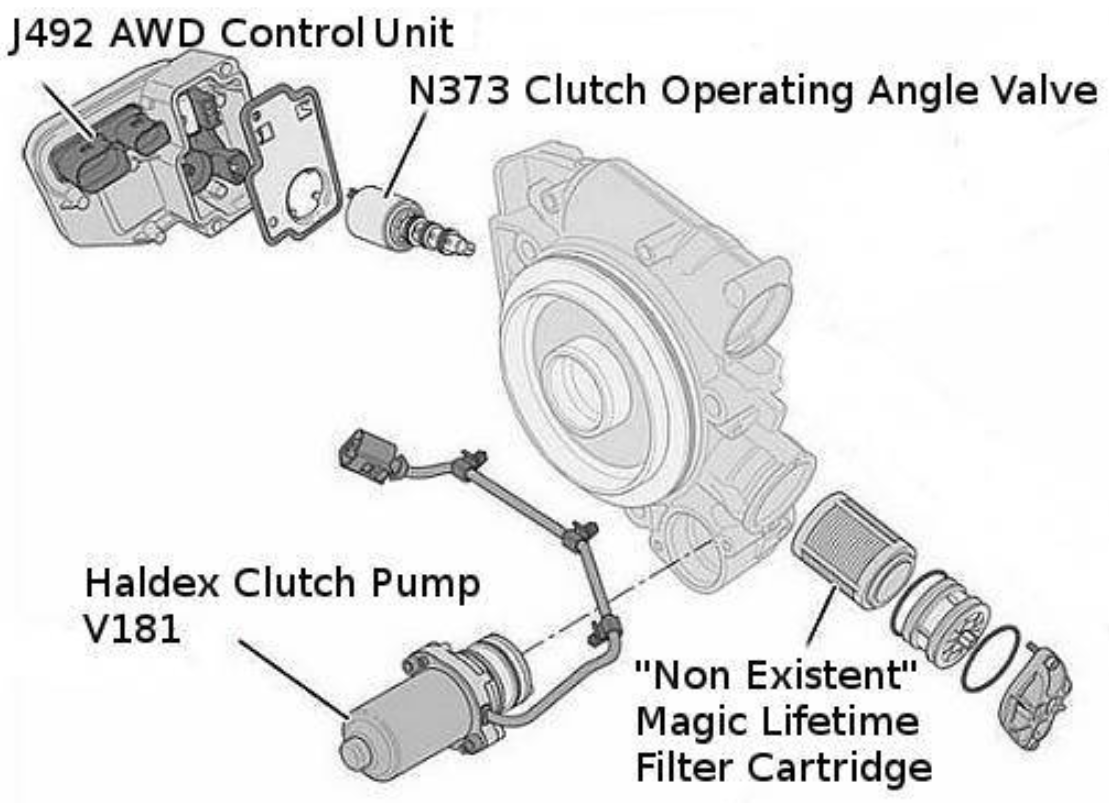
- “Haldex Clutch Pump (V181)” mesh oil pump.
- Filter cartridge.
- Pressure accumulator (piston with a spring that holds the precharge pressure for instant need).
- Oil Control Solenoid "Clutch Angle Control Valve (N373)".
- A wet clutch pack like a motorcycle clutch that clamps together with a piston type actuator built into the assembly.
- An ECU that is subordinate to the ABS/TC/ESP ECU.
VW Audi reduced the specifications of the 4th generation Haldex system by ditching the pressure sensor that was in the 2nd generation systems. He determined the oil pressure created by the pump and filter system. It was a diagnostic sensor, it had no other purpose than to detect a system failure. Without this sensor, the system does not see the efficiency of pumping/pressurizing. Second, VW / Audi never designed and manufactured the 4th generation Haldex system, so they neglected its service and maintenance requirements.
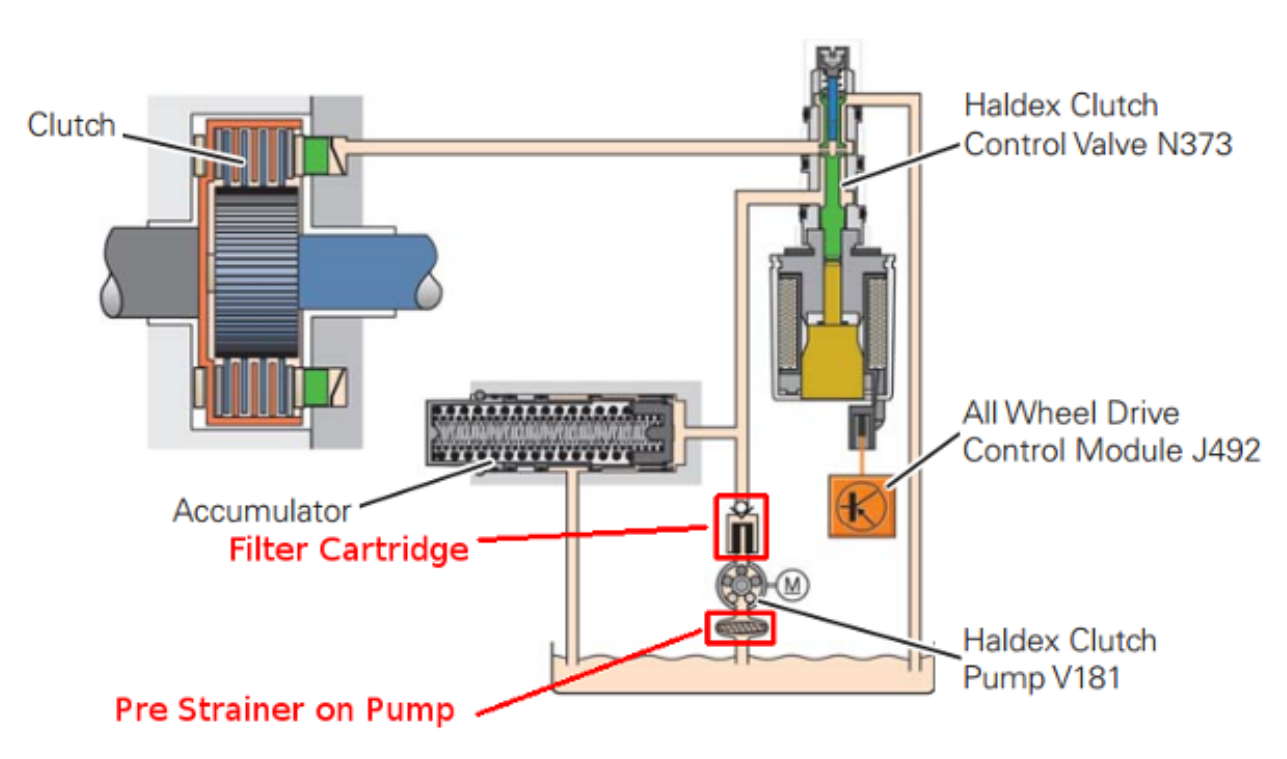
When the ABS/TC/ESP ECU detects that the front wheels are turning faster than the rear wheels via the ABS wheel speed sensors, the Haldex ECU signals the engagement of the Haldex clutch pack, thus engaging the AWD system. It reacts very quickly, usually engaging the four-wheel drive system after about 90 degrees of front wheel slip. It then keeps the AWD system engaged until the torque request from the engine ECU drops. The system turns off if the foot or handbrake is engaged.
The Haldex system is not manufactured or developed by the VW/Audi group. It was derived from Haldex Drive Train drive systems. The Haldex ECU is programmed and the PCB is configured to VW/Audi group specifications. Although outwardly the ECUs are identical to Volvo, Landrover, Vauxhall and Ford ECUs, internally they have different areas of the PCB and have different firmware/flash memory on the microprocessor, so they use different communication protocols for different manufacturers.
The mechanical equipment of the Haldex clutch/coupling is quite robust and does not suffer from mechanical damage. Out of approximately 800 VW/Audi vehicles I have worked on, only 2 vehicles have had a mechanical failure so far, both of which were modified power vehicles.
To diagnose and work on Haldex-equipped VW/Audi Gen 4 vehicles, the workshop must use VAGCOM/VCDS scan equipment (preferred) or "aftermarket" scan equipment that can be connected directly to the ID "22 - AWD" control unit and read live data from the ECU and run output tests on the "Clutch Operating Angle Control Valves (N373)" and "Haldex Clutch Pumps (V181)". Such equipment includes Launch Pro X431, Autel Maxisys MS908, some Snap-On scanning equipment, Bosch KTS and Delphi/Autocom DS150E. The above aftermarket equipment has different functions depending on the version and software updates.
Pump failure
Fault codes
- 00448 – Haldex clutch pump (V181) – 002 – lower limit exceeded – intermittent.
- 00448 – Haldex clutch pump (V181) 011 – break – intermittent.
- 00448 - Haldex clutch pump (V181) 011 - break - faulty.
- 00448 – Haldex clutch pump (V181) – 011 – break – intermittent.
Reasons
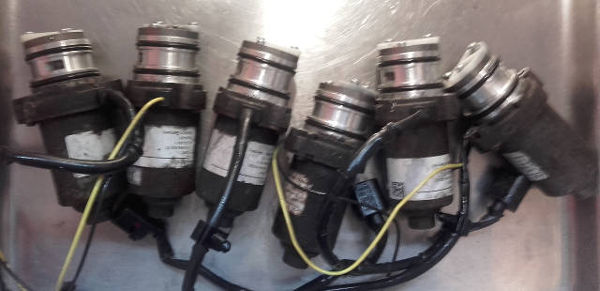
The pump runs every 20 seconds or so to keep the system running, the ECU turns the engine on for 2 seconds and turns off again. This causes the brushes to wear, this can usually be checked by running the pump from VAGCOM/VCDS using the output check function. If the pump does not work, gently tap the pump a few times with a metal object, usually the pump will come back to life. This is not a fix, it is proof that the pump is faulty.
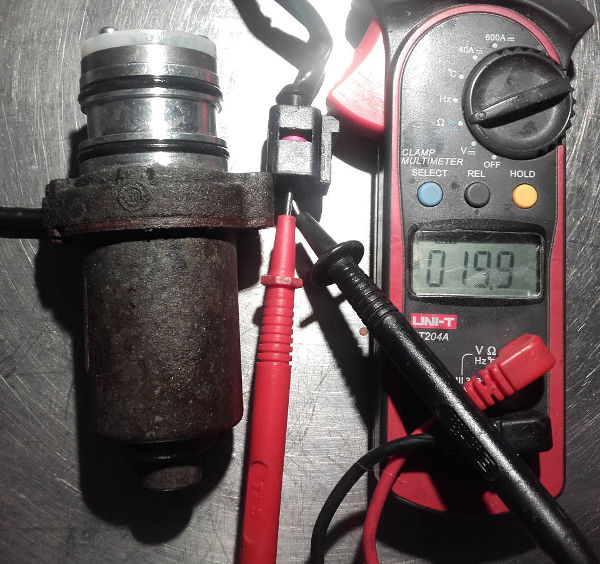
You can check the operation of the pump with a multimeter set to the Ohm Resistance setting and connected to the two terminals of the pump multi-connector, polarity does not matter. A good pump will measure between 5 and 8 ohms. Below or above this specification indicates a faulty pump. Bad pumps often show very high resistance values, very low values or an open circuit. Connecting 12V to the pump to run it is an option, but it's far from a convincing test method. Some pumps will be intermittently open, e.g. they test normal some power cycles and then test out of spec the next, this is due to worn motor brushes and commutator.
Pumps usually burn out because the filter is clogged with scale. Cars usually clog the filter between 45,000 and 80,000 miles. But I have seen a Golf R with only 17k miles on the clock with a clogged filter. No set mileage, more dependent on activation/use of Haldex clutch package. ALWAYS replace the filter when replacing the pump. It is a consumable and if it gets clogged the new pump will burn out in a short period of time, e.g. weeks/months.
Decision
Change the filter, pump and oil using the correct method.
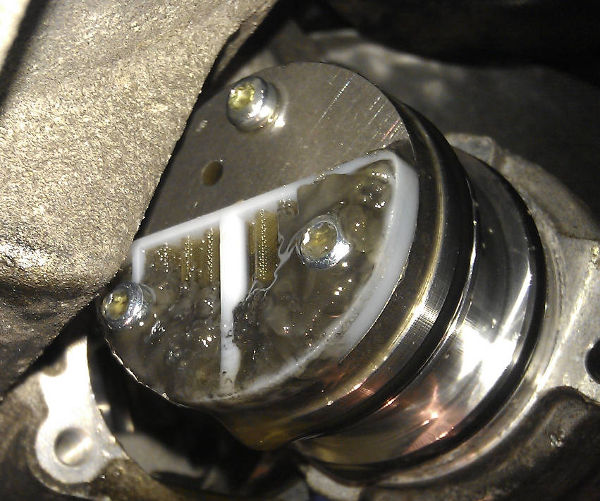
Clogged filter failure
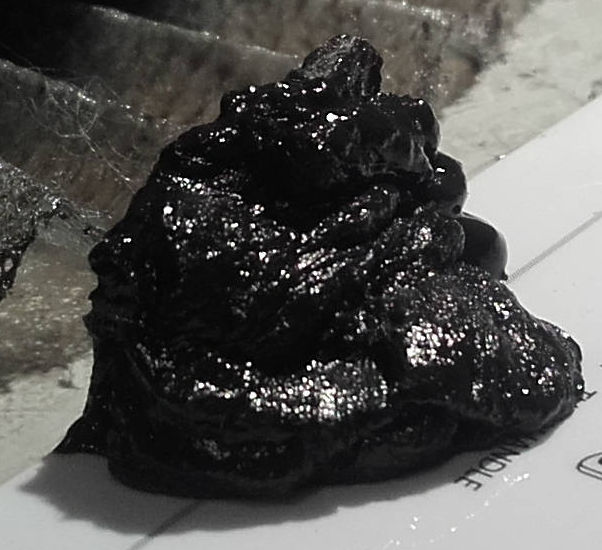
Fault codes
- 02248 – valve for controlling the working angle of the clutch (N373) – intermittent.
- 01155 - clutch - 003 - mechanical failure - intermittent.
Causes/diagnosis:
The wear material of the clutch pack is suspended in Haldex clutch oil. First, large particles are filtered out with a pre-screen filter on the pump, and then smaller residues/particles are filtered out with a cartridge filter. According to VW/Audi this filter does not exist!! Since the oil does not pass through the filter cartridge, the oil pressure required to clamp the Haldex clutch pack under load is not provided. This causes the clutch pack to slip (causing more wear and further clogging of the filter!) so the ABS/ASC/TCS system detects the front wheels turning faster than the rear, which shouldn't be possible with the Haldex clutch engaged, so the fault codes generated are concentrated on clutch and check valve n373. CAUTION - A pre-replacement Haldex V181 pump that is no longer providing adequate oil pressure will also give the same symptoms and usually test above or below the 5 to 8 ohm resistance specification. Wheel jumps/skips when cornering tight turns in parking lots etc. A feeling of binding when making sharp turns.
Decision
Change the filter, oil and clean the pre-filter of the pump.
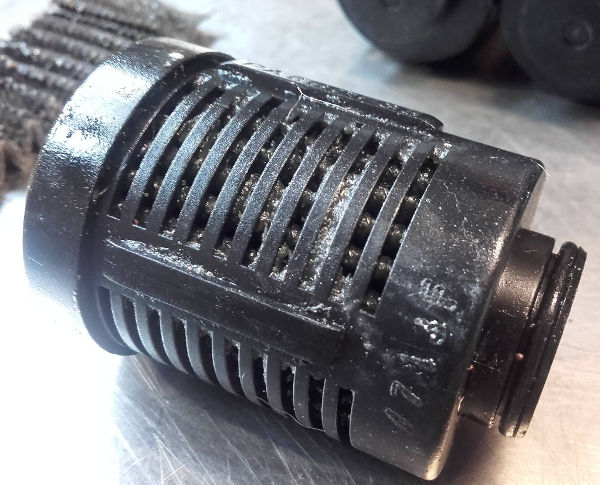
ECU malfunction
Fault codes
- 02248 – The clutch operating angle control valve (N373) is faulty.
- 02248 – Clutch operating angle control valve (N373) – intermittent.
- 02248 – Valve for controlling the working angle of the clutch (N373) – 012 – electrical error in the circuit.
- 01324 - Four Wheel Drive Control Module (J492) 004 - No Signal/Communication.
- 65535 – Control module internal memory error 00-10 – intermittent.
- 16347 – Control Module – EEPROM Error – 014 – Faulty – Intermittent.
- 00003 – Control Module 014 – Faulty – Intermittent / sporadic faulty control module.
Diagnosis
This can manifest itself in a hidden way on Haldex 4 generation cars. It can throw any of the above fault codes and even pump fault codes. Because it depends on which area of the PCB is corroded and/or burned out. The easiest way to prove that the ECU is faulty is to open the ECU. To do this, cut all the black rubberized sealant from the front cover, carefully remove the cover - do not stick anything under the cover - do not scratch the circuit board or components. Then carefully inspect the ECU PCB for corrosion or burnt components on the front bottom edge of the PCB. About 15% of all 4th generation Haldex malfunctions were faulty ECUs. I can test these ECUs and many are repairable - depending on how bad the burn and/or corrosion is. Wheel jumps/skips when cornering tight turns in parking lots etc. A feeling of binding when making sharp turns.
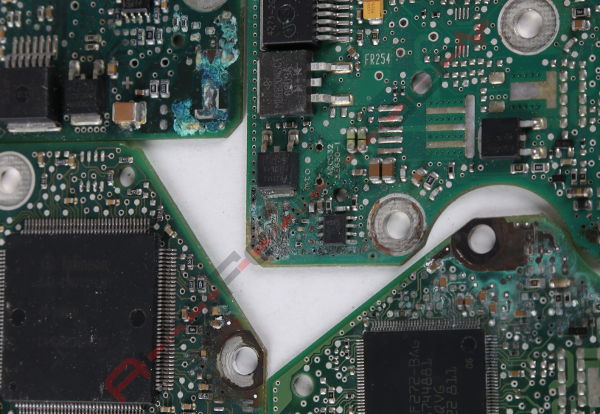
Decision
Repair or replace the Haldex ECU. It is advisable to replace the filter and oil. Often the life of the pump is over.