Requirements for mixture formation and combustion. 1.9 TDI PD from VAG Group. Family of diesel engines with injection pump-injector

AvtoAd
10/05/2022
Successful mixture formation is a vital factor for efficient combustion. Accordingly, the fuel must be injected in the right amount at the right time and under high pressure. Even minimal deviations can lead to increased pollutant emissions, noisy combustion or excessive fuel loss. A short ignition delay is important for the sequence of combustion of a diesel engine. Ignition delay is the period between the start of fuel injection and the beginning of the pressure in the combustion chamber. If a large amount of fuel is injected during this period, the pressure rises sharply and causes a loud combustion noise.
Phase before injection
A small amount of fuel is injected under low pressure to mitigate the combustion process before the start of the main injection phase. This is the pre-injection phase. Combustion of this small amount of fuel causes an increase in pressure and temperature in the combustion chamber. This meets the requirements of rapid ignition of the main amount of injection, thus reducing the ignition delay. The pre-injection phase, the "injection interval" between the pre-injection phase and the main injection phase provoke a gradual increase in pressure in the combustion chamber, rather than a sudden increase in pressure. The result is low combustion noise and lower nitrogen oxide emissions.
The main phase of injection
The main requirement for the main injection phase is the formation of a good mixture. The goal is to burn the fuel completely if possible. The high injection pressure finely sprays the fuel so that the fuel and air can mix well with each other. Complete combustion reduces pollutant emissions and ensures high engine efficiency.
End of injection
At the end of the injection process, it is important that the pressure drops quickly and the injector needle closes quickly. This prevents fuel from entering the combustion chamber at low injection pressures and with large droplet diameters. Under such conditions, the fuel does not burn completely, and this provokes an increase in emissions of pollutants.
Injection process
1. Filling the high pressure chamber.
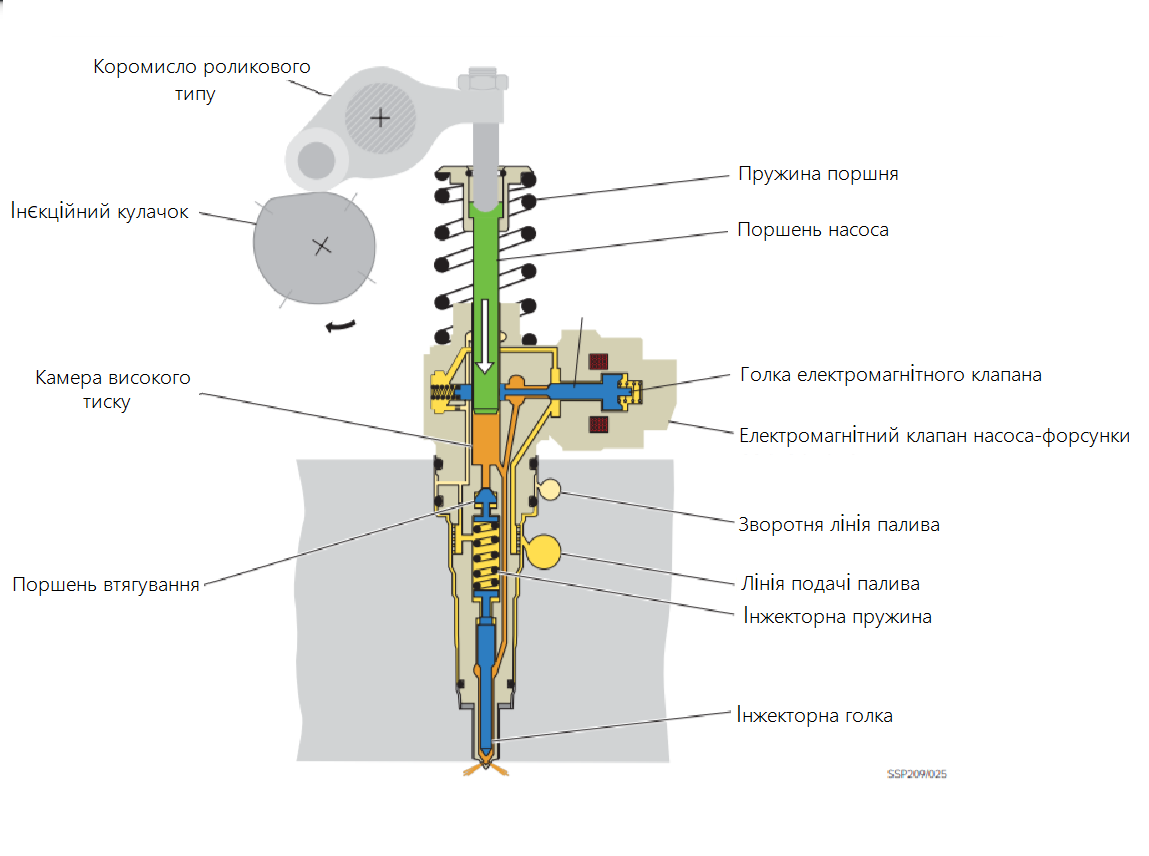
During the filling phase, the piston of the pump moves upwards under the action of the piston spring and thus increases the volume of the high pressure chamber. The injector pump solenoid valve is not activated. The solenoid valve needle is at rest. The path from the fuel supply line to the high pressure chamber is open. The fuel pressure in the pipeline causes the fuel to enter the high pressure chamber.

2. Phase before injection.
The injection cam pushes the pump piston down with a roller rocker arm. This pushes some of the fuel out of the high pressure chamber back into the fuel line. The J248 Direct Fuel Injection Engine Control Module initiates the injection cycle by activating the injector pump solenoid valve. The solenoid valve needle is pressed into the valve seat and closes the path from the high pressure chamber to the fuel supply line. This provokes an increase in pressure in the high pressure chamber. At a pressure of 2611 pounds per square inch (18,000 kPa / 180 bar), the injector needle rises from its socket, and the cycle begins before injection.
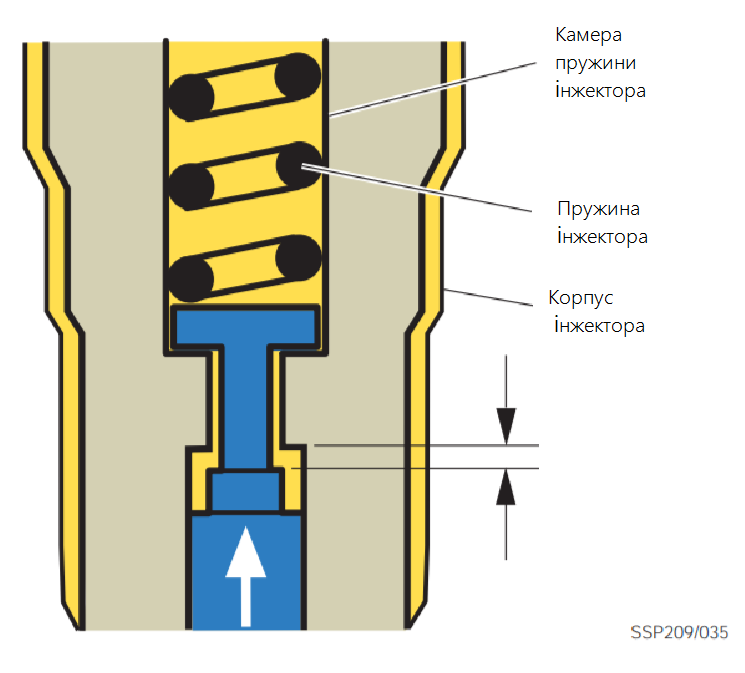
During the pre-injection phase, the stroke of the injector needle is damped by a hydraulic cushion. As a result, you can accurately measure the injection volume. In the first third of the overall process, the injector needle opens without quenching. The volume of pre-injection is injected into the combustion chamber.
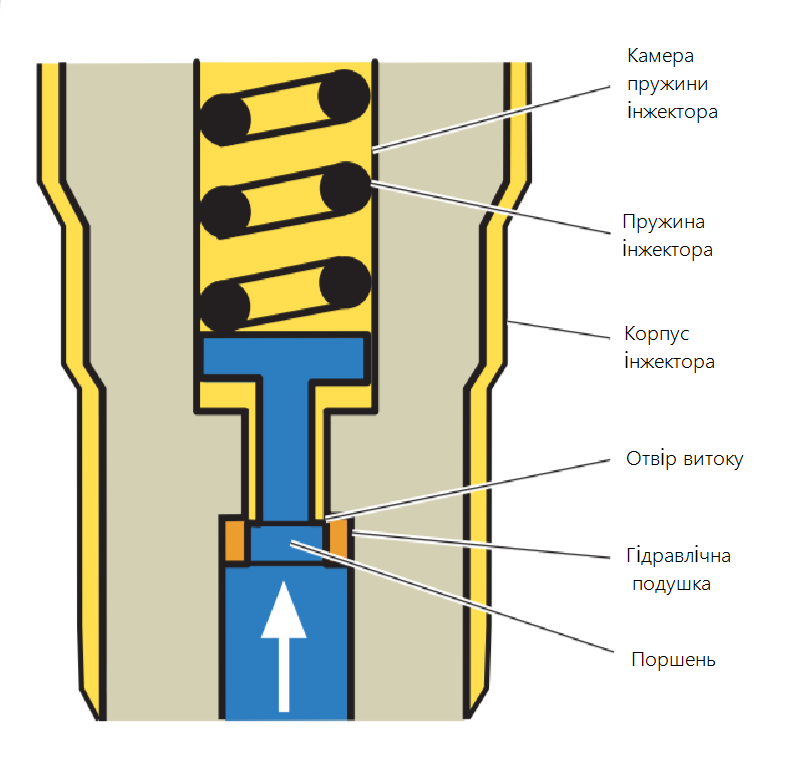
As soon as the shock-absorbing piston is immersed in the hole of the injector body, the fuel above the injector needle is pushed into the chamber of the injector spring only through the leakage hole. This creates an hydro-hydraulic cushion that limits the stroke of the injector needle during the pre-injection phase.
3. End of phase before injection.
The pre-injection phase ends immediately after opening the injector needle. Increasing the pressure causes the suction piston to move downward, thereby increasing the volume of the high pressure chamber. As a result, the pressure drops for a moment and the injector needle closes. At this stage, the movement of the piston is pulled down more strongly and loads the injector spring. To reopen the injector needle during the next main injection phase, the fuel pressure must be higher than during the pre-injection phase.

4. The beginning of the main phase of injection.
The pressure in the high pressure chamber rises again shortly after closing the injector needle. The solenoid valve of the injector pump remains closed and the pump piston moves down. At approximately 4351 psi (30,000 kPa / 300 bar), the fuel pressure exceeds the force exerted by the preloaded injector spring. The injector needle rises from its place again and the main amount of injection is given. The pressure rises to 27,121 pounds per square inch (187,000 kPa / 1,870 bar) to 27,846 pounds per square inch (192,000 kPa / 1920 bar). Maximum fuel pressure is reached at maximum engine power. This occurs at high engine speeds when a large amount of fuel is injected.

5. The main phase of injection.
The injection cycle ends when the J248 direct fuel injection control module no longer activates the injector solenoid valve. The solenoid valve spring opens the solenoid valve needle, and fuel displaced by the pump piston can enter the fuel line. The pressure drops. The injector needle closes and the injector spring presses the bypass piston to its original position. This concludes the main phase of the injection.

6. Return of fuel by the pump-injector.
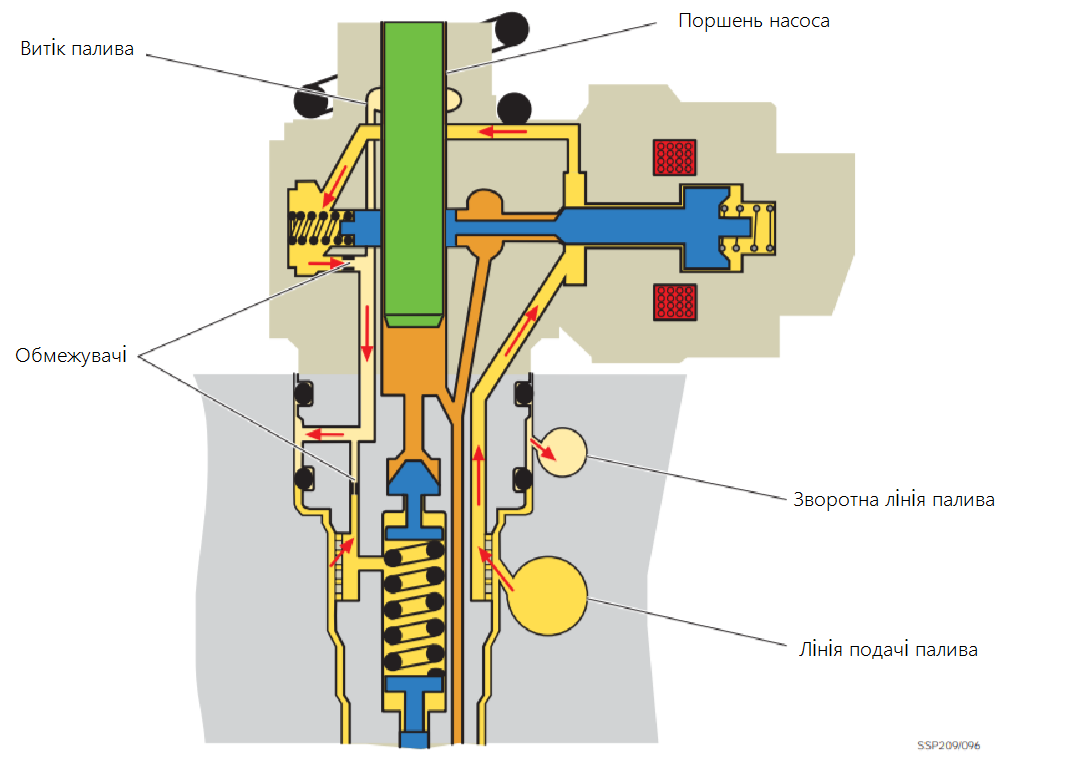
The fuel is returned by the injector pump in the following order:
- Cooling of the injector pump by flushing the fuel from the fuel supply line through the injector pump channels into the return fuel line;
- Leakage of fuel outlet through the pump piston;
- Separation of bubble vapor from the fuel line of the injector pump through the limiters in the return fuel line.
Read more about the family of diesel engines with injection pump-injector here .