Mechanical gearbox. Robotic checkpoint

AvtoAd
25/02/2023
Content
2. The principle of operation of a robotic gearbox.
4. The specifics of the RCPP work.
5. Features of the DSG robotic gearbox.
6. Advantages and disadvantages.
Any modern car cannot start and move smoothly if there is no transmission in its device. Today, there is a wide variety of all kinds of gearboxes, which not only allow the driver to choose the option that corresponds to his financial capabilities, but also allow him to get maximum driving comfort. Let's talk in more detail about what a robotic gearbox is, its main differences from a mechanical one, and also consider the principle of operation of this unit.
What is a robotic gearbox
The operation of the gearbox is almost identical to its mechanical counterpart, except for some features. The mechanism of the system includes many parts that make up the already familiar mechanical version of the box. The main difference of the robotic gearbox is its microprocessor-type control. In such gearboxes, gear shifting is performed by electronics based on data from the engine, gas pedal and wheel sensors.

A robotic box can also be called an automaton, but this is a misnomer. The fact is that automatic transmission is often used as a general concept. Yes, the same variator has an automatic mode for switching gear ratios, so it seems that it is also an automatic. In fact, in terms of structure and principle of operation, the robot is more similar to a mechanical box.
Externally, it is impossible to distinguish an automatic transmission from a manual transmission, since they can have an identical selector and housing. You can check the transmission only while the car is moving. Each type of unit has its own features of operation.
The main purpose of the robotic transmission is to make driving as easy as possible. The driver does not need to switch gears himself, because the work is done by the control unit. In addition to comfort, manufacturers of automatic transmissions strive to make their products cheaper. To date, the robot is the most budget-friendly type of gearbox after mechanics, but it does not provide such driving comfort as a variator or an automatic.
The principle of operation of the robotic gearbox
The robotic transmission can switch to the next gear automatically or semi-automatically. In the first case, the microprocessor unit receives signals from sensors, on the basis of which the algorithm programmed by the manufacturer is triggered.

Most gearboxes are equipped with a manual selector. In this case, the speeds will still be included automatically. The only thing is that the driver can independently signal the moment of switching on a higher or lower gear. Some automatic transmissions of the Tiptronic type have a similar working principle.
To increase or decrease speed, the driver moves the selector lever in the + or - direction. Due to this option, some people refer to this transmission as serial or sequential.
The robotic box works according to the following scheme:
- The driver applies the brake, starts the engine and moves the drive mode switch to position D;
- The signal from the unit is sent to the box control unit;
- Depending on the selected mode, the control unit activates the corresponding algorithm, according to which the unit will work;
- In the process of movement, the sensors transmit signals to the "robot brain" about the speed of the car, about the load on the power unit, as well as about the current mode of operation of the gearbox;
- As soon as the indicators no longer correspond to the program installed from the factory, the control unit gives the command to switch to another gear. It can be both an increase and a decrease in speed.

When a driver drives a car with a manual transmission, he must feel his car to determine when to shift to another gear. In the robotic analogue, a similar process takes place, only the driver does not need to think about when to move the gearbox lever to the required position. Instead, it is done by the microprocessor.
The system monitors all information from all sensors and selects the optimal transmission for a specific load. In order for the electronics to switch gears, the transmission has a hydromechanical drive. In a more common version, instead of hydromechanics, an electric drive or servo drive is installed, which engages / disengages the clutch in the box (by the way, this has some similarities with an automatic transmission - the clutch is not located where it is in a manual transmission, namely near the flywheel, but in the housing of the transmission itself) .
When the control unit signals that it is time to switch to another speed, the first electric (or hydromechanical) servo is turned on first. It opens the friction surfaces of the clutch. The second servo then moves the gears of the mechanism to the desired position. Then the first slowly releases the clutch. This design allows the mechanism to work without the participation of the driver, so a car with a robotic transmission does not have a clutch pedal.
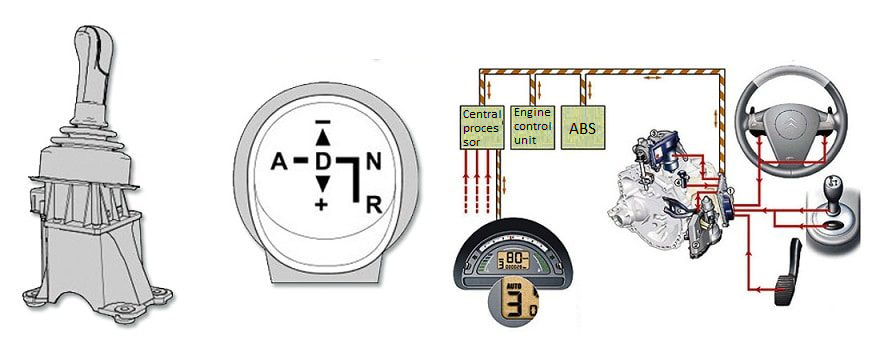
Many selectors have a fixed gear position. This so-called tiptronic allows the driver to independently control the moment of switching to a higher or lower speed.
The device of the robotic gearbox
Today, there are several types of robotic transmissions for passenger cars. In some drives, they may differ from each other, but the main parts remain identical.
Here are the components included in the gearbox:
- Clutch. Depending on the manufacturer and modification of the unit, it can be one part with a friction surface or several disks of the same type. Most often, these elements are located in the coolant, which stabilizes the operation of the unit, preventing its overheating. The preselective or double option is considered more effective.
- The main part is an ordinary mechanical box. Each manufacturer uses different patented designs. For example, the robot from the Mercedes brand (Speedshift) has an internal automatic gearbox 7G-Tronic. The only difference between the units is that instead of a torque converter, a clutch with several friction discs is used. BMW has a similar approach. Its SMG transmission is based on a six-speed manual transmission.
- Clutch and transmission drive. There are two options - with an electric drive or a hydromechanical analogue. In the first case, the clutch is squeezed by an electric motor, and in the second - by hydraulic cylinders with EM valves. The electric drive works more slowly than hydraulics, but does not need to maintain constant pressure in the main line, from which the electro-hydraulic type works. The hydraulic robot moves to the next stage much faster (0.05 seconds versus 0.5 seconds for the electric counterpart). An electric gearbox is mainly installed on budget cars, and a hydromechanical gearbox is installed on premium sports cars, since the speed of shifting gears without stopping the power supply to the drive shaft is extremely important.
- Sensor. The robot has a lot of such details. They monitor many different parameters of the transmission, for example, the position of the forks, the revolutions of the input and output shafts, in which position the selector is locked, the temperature of the coolant, etc. All this information is sent to the mechanism control device.
- The ECU is a microprocessor unit in which various algorithms are programmed with various indicators coming from the sensors. This unit is connected to the main control unit (data on engine operation is received from there), as well as to electronic wheel locking systems (ABS or ESP).
- Executive mechanisms - hydraulic cylinders or electric motors, depending on the modification of the box.
The specifics of the RCPP work
For a smooth start of the car, the driver must use the clutch pedal correctly. After he engages first or reverse gear, he needs to release the pedal smoothly. When the driver feels the engagement of the wheels, releasing the pedal, he can rev up the engine to keep the car from stalling. This is how mechanics work.
An identical process occurs at work. Only in this case, great skill is not required from the driver. He only needs to move the box switch to the appropriate position. The car will start moving according to the settings of the control unit.

The simplest modification with one clutch works in the same way as the classic mechanics. However, there is one problem - the electronics do not record feedback from the clutch. If a person is able to determine how smoothly it is necessary to release the pedal in one or another case, then the automation works more rigidly, so the movement of the car is accompanied by noticeable jerks.
This is especially felt in modifications with an electric drive of the actuators - while the gear is being switched, the clutch will be in an open state. This will mean a break in the flow of torque, due to which the car begins to brake. Since the rotation speed of the wheels is already less than the engaged gear, a slight jerk occurs.
An innovative solution to this problem was the development of a modification with a double clutch. A bright representative of such a transmission is the Volkswagen DSG. Let's take a closer look at its features.
Features of the DSG robotic gearbox
The abbreviation stands for direct-shift gearbox. In fact, these are two mechanical boxes installed in the same housing, but with one connection point to the chassis of the car. Each mechanism has its own clutch.
The main feature of this modification is the preselective mode. That is, while the first shaft works with the gear engaged, the electronics already connects the corresponding gears (when accelerating to increase the gear, when braking - to decrease) of the second shaft. The main drive only needs to disengage one clutch and engage the other. As soon as a signal is received from the control unit about switching to another stage, the working clutch is disengaged, and the second one with already engaged gears is immediately engaged.
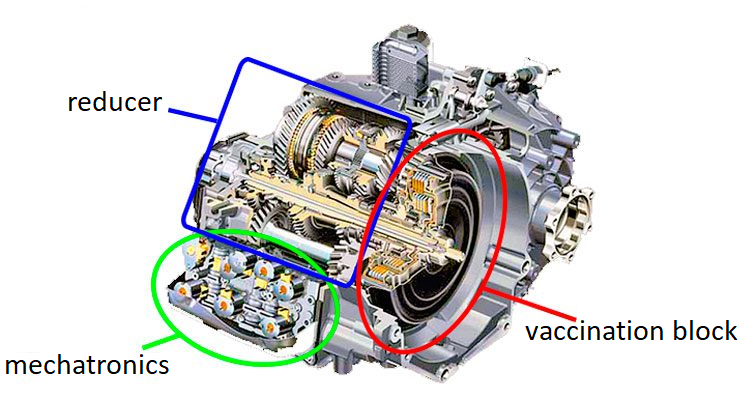
This design allows you to drive without strong jerks during acceleration. The first developments of preselective modification appeared in the 80s of the last century. However, then robots with a double clutch began to be installed on rally and racing cars, in which the speed and accuracy of gear shifting are of great importance.
If you compare the DSG box with a classic automatic, the first option has more advantages. Firstly, due to the more familiar structure of the main elements (the manufacturer can take any ready-made mechanical analogue as a basis), such a box will be cheaper to sell. The same factor affects the maintenance of the unit - the mechanics are more reliable and easier to repair.
This allowed the manufacturer to install an innovative transmission on budget models of its products. Secondly, many owners of vehicles with such a gearbox note an increase in the economy of the car in comparison with an identical model, but with a different gearbox.

Advantages and disadvantages
The considered type of transmission has both positive and negative sides. The advantages of the box include:
- Such a transmission can be used in conjunction with a power unit of almost any capacity;
- Compared to the variator and the automatic, the robotic version is cheaper, although it is quite an innovative development;
- Robots are more reliable than other automatic transmissions;
- Due to the internal similarity with mechanics, it is easier to find a specialist who will undertake the repair of the unit;
- More efficient gear shifting allows you to use engine power without a critical increase in fuel consumption;
- Thanks to increased efficiency, the machine emits fewer harmful substances into the environment.

Despite the obvious advantages over other automatic transmissions, the robot has several significant disadvantages:
- If the car is equipped with a single-disc robot, then the trip on such a vehicle cannot be called comfortable. When switching gears, there will be noticeable jerks, as if the driver suddenly throws the clutch pedal on the mechanics.
- Most often, the clutch (lower smoothness of inclusion) and executive mechanisms fail in the unit. This complicates the repair of transmissions, as they have a short service life (about 100 thousand kilometers). Servos are rarely repairable and a new mechanism is expensive.
- As for the clutch, the resource of the disc is also very small - about 60 thousand. Moreover, at about half of the resource, it is necessary to "connect" the box under the conditions of the friction surface of the parts.
- If we talk about the preselective DSG modification, it turned out to be more reliable due to the shorter time it takes to switch gears (thanks to this, the car does not brake as much). Despite this, they still suffer from adhesion.
- Taking into account the listed factors, we can draw a conclusion: there are still no equals in terms of reliability and service life of the mechanics. If the emphasis is on maximum comfort, then it is better to choose a variator (what is its special feature, read here). It should be borne in mind that such a transmission will not provide an opportunity to save fuel.