MacPherson suspension device

AvtoAd
02/02/2023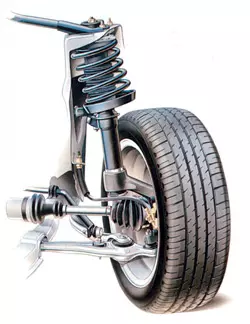
Recently, the "swinging candle" type suspension (MacPherson suspension) has become widespread. It consists of one lever and a telescopic rack, on one side rigidly connected to the rotary fist, and on the other - fixed in the heel. The heel is a thrust bearing mounted in a soft rubber block mounted on the body. The rack can sway due to the deformation of the rubber block and turn around the axis passing through the thrust bearing and the lever external hinge.

Advantages of MacPherson suspension
- A small number of details.
- The smallest mass.
- Space in the engine compartment or trunk. Usually, the suspension rack is combined with the shock absorber, and the elastic element (spring, pneumatic element) is installed on the rack.
- Low production costs compared to similar systems on double transverse levers.
- A large operational resource of the upper support of the shock-absorbing rack designed in the form of a rolling bearing.
- Compact dimensions and relatively low weight provide excellent dynamic characteristics, even for cars with medium power engines.
- Easy fault diagnosis: slight knocking and instability of the car when driving at high speed indicates wear of suspension parts.
Disadvantages of MacPherson suspension
- Increased wear of guide elements of the rack with large suspension strokes.
- Limited possibilities for varying kinematic schemes and a high level of noise (compared to a suspension on two transverse arms).
- Loss of stability when driving at high speed and when braking sharply. The cause of instability is a significant change in the position of the wheel of the vertical axis due to an increase or decrease in the stroke of the shock absorber.
- MacPherson suspension is not intended for use in off-road conditions. When driving on a bad road, the parts of the struts are destroyed, as a result, the so-called fatigue cracks are formed on the fender, and the corrosion process begins.
- Constant pressure damages shock absorbers, so the McPherson suspension cannot withstand heavy loads. Therefore, this type of suspension is not suitable for operation on sports cars, trucks, as well as SUVs and cars with frame construction.
- Regarding complex repairs. The complex design of the suspension does not allow for point-in-time replacement of worn parts. Service station employees have to completely disassemble the system, which increases the time and cost of repairs.

MacPherson suspension device
.png)
Suspension with an oscillating shock absorber has a forged lever to which the stabilizer arm is connected through rubber pads. The transverse part of the stabilizer is attached to the cross member of the body with rubber cushions and steel staples. Thus, the diagonal arm of the stabilizer transmits the longitudinal forces from the wheel to the body and, therefore, forms part of the integrated lever of the suspension guide device. Rubber cushions make it possible to compensate for distortions that occur during the oscillation of such a folded lever, and also dampen longitudinal vibrations transmitted from the wheel to the body.
The rod of the telescopic rack is fixed on the lower base of the rubber block of the upper heel and does not turn together with the rack and the spring installed on it. In this case, with any turns of the steered wheels, the rack also turns relative to the rod, removing the friction of rest between the shock absorber rod and its guide, shock absorber piston and cylinder, which improves the suspension's response to small road bumps.
The spring is not installed coaxially on the rack, but is inclined towards the wheel in order to reduce the transverse loads on the rod, its guide and the piston arising under the influence of vertical force on the wheel.
A feature of the steering wheel suspension is that it should allow the wheel to turn regardless of the deflection of the elastic element. This is ensured with the help of the so-called pin assembly. Suspensions can be pivoted and pivotless.
With a pivoted suspension, the steering knuckle is mounted on a pivot mounted with some inclination to the vertical on the suspension strut. To reduce the friction moment in this joint, needle, radial, and deep groove ball bearings can be used. The outer ends of the suspension arms are connected to stable cylindrical joints, usually made in the form of sliding bearings that are lubricated.
The main disadvantage of the pivot design is the large number of hinges. When swinging the levers of the guide device in the transverse plane, it is impossible to achieve the "anti-jaw effect" due to the presence of the center of the longitudinal roll of the suspension, since the axes of swinging of the levers must be strictly parallel.
Independent boltless suspensions are very common, where the cylindrical joints of the rack are replaced by spherical ones. The construction of this joint includes a finger with a hemispherical head, a metal-ceramic support insert is fitted to it, which works on the spherical surface of the joint body. The finger rests on a tab made of special rubber with a nylon coating, installed in a special clip. The hinge housing is attached to the suspension lever. When turning the wheel, the finger rotates around the axis in the inserts. When the suspension bends, the finger together with the insert swings around the center of the sphere - for this there is an oval hole in the case. This joint is load-bearing because it transmits the vertical forces from the wheel to the spring element resting on the lower spring suspension arm. The suspension levers are attached to the body either with the help of cylindrical sliding bearings or with the help of rubber-metal hinges that work due to the shear deformation of the rubber bushings. The latter require lubrication and have a vibration-isolating property.