Air fuel ratio

AvtoAd
16/08/2023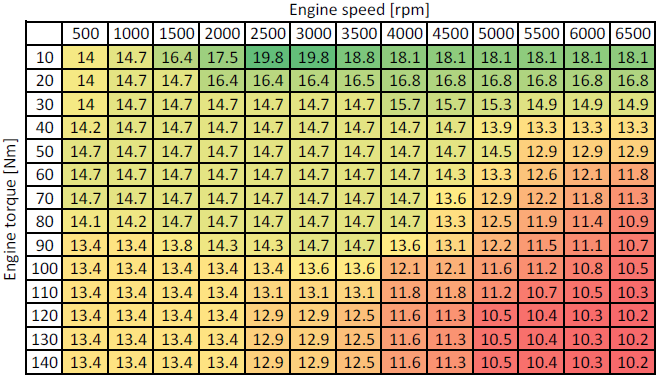
Content:
- Air-fuel ratio formula
- The ratio of air and fuel for different types of fuel
- How is the stoichiometric ratio of air and fuel calculated
- Lambda air-fuel coefficient
- Air-fuel ratio and engine performance
- Effect of air-fuel ratio on engine emissions
- Lambda control with a closed combustion circuit
1. Determination of the air-fuel ratio
Heat engines use fuel and oxygen (from the air) to produce energy through combustion. To ensure the combustion process, a certain amount of fuel and air must be supplied to the combustion chamber. Complete combustion occurs when all the fuel is burned, leaving no unburned fuel in the exhaust.
The air-fuel ratio is defined as the ratio of air and fuel in the mixture prepared for combustion. For example, if we have a mixture of methane and air that has an air-fuel ratio of 17.5, this means that we have 17.5 kg of air and 1 kg of methane in the mixture.
The ideal (theoretical) ratio of air and fuel for complete combustion is called the stoichiometric ratio of air and fuel . For a gasoline (petrol) engine, the stoichiometric ratio of air to fuel is approximately 14.7:1. This means that for complete combustion of 1 kg of fuel, we need 14.7 kg of air. Combustion is possible even if the AFR is different from stoichiometric. For combustion to occur in a gasoline engine, the minimum AFR is around 6:1, and the maximum can reach 20:1.
When the air-fuel ratio is higher than the stoichiometric ratio, the air-fuel mixture is called lean . When the proportion of air in the fuel is lower than the stoichiometric ratio, the air-fuel mixture is called rich . For example, for a gasoline engine, an AFR of 16.5:1 is lean and 13.7:1 is rich.
2. Air-fuel ratio formula
In the context of internal combustion engines , the air-fuel ratio (AF or AFR) is defined as the ratio between the mass of air m a and the mass of fuel m f used by the engine during operation:
AFR=mamf(1)
The inverse ratio is called the fuel-air ratio (FA or FAR) and is calculated as:
FAR=mfma=1AFR(1)
3. Ratio of air and fuel for different types of fuel
In the table below we can see the stoichiometric ratio of air to fuel for several fossil fuels.
| Fuel | Chemical formula | AFR |
| Methanol | CH 3 OH | 6.47:1 |
| Ethanol | C 2 H 5 OH | 9:1 |
| Butanol | C 4 H 9 OH | 11.2:1 |
| Diesel | C 12 H 23 | 14.5:1 |
| Gasoline | C 8 H 18 | 14.7:1 |
| Propane | C 3 H 8 | 15.67:1 |
| Methane | CH 4 | 17.19:1 |
| Hydrogen | H 2 | 34.3:1 |
Source: wikipedia.org
For example, to completely burn 1 kg of ethanol, 9 kg of air is needed, and to burn 1 kg of diesel fuel, 14.5 kg of air is needed.
Spark-ignition (PI) engines usually run on gasoline (petrol). The AFR of SI engines ranges from 12:1 (rich) to 20:1 (lean) depending on engine operating conditions (temperature, speed, load, etc.). Modern internal combustion engines run as much around the stoichiometric AFR as possible (mainly for gas aftertreatment reasons). In the table below you can see an example of an engine SI AFR, a function of engine speed and torque.

Image: Example of Air Fuel Ratio (AFR) as a function of engine speed and torque
Compression ignition (CI) engines typically run on diesel fuel. Due to the nature of the combustion process, CI engines always run on lean mixtures with AFRs between 18:1 and 70:1. The main difference compared to SI engines is that CI engines operate on stratified (inhomogeneous) air-fuel mixtures, while SIs operate on homogeneous mixtures (in the case of port-injection engines).
The above table is entered into a Scilab script and a contour plot is created.
EngSpd_rpm_X = [500 1000 1500 2000 2500 3000 3500 4000 4500 5000 5500 6000 6500];
EngTq_Nm_Y = [10;20;30;40;50;60;70;80;90;100;110;120;130;140];
EngAFR_rat_Z = [14 14.7 16.4 17.5 19.8 19.8 18.8 18.1 18.1 18.1 18.1 18.1 18.1;
                14 14.7 14.7 16.4 16.4 16.4 16.5 16.8 16.8 16.8 16.8 16.8 16.8;
                14 14.7 14.7 14.7 14.7 14.7 14.7 15.7 15.7 15.3 14.9 14.9 14.9;
                14.2 14.7 14.7 14.7 14.7 14.7 14.7 14.7 14.7 13.9 13.3 13.3 13.3;
                14.7 14.7 14.7 14.7 14.7 14.7 14.7 14.7 14.7 14.5 12.9 12.9 12.9;
                14.7 14.7 14.7 14.7 14.7 14.7 14.7 14.7 14.3 13.3 12.6 12.1 11.8;
                14.7 14.7 14.7 14.7 14.7 14.7 14.7 14.7 13.6 12.9 12.2 11.8 11.3;
                14.1 14.2 14.7 14.7 14.7 14.7 14.7 14.7 13.3 12.5 11.9 11.4 10.9;
                13.4 13.4 13.8 14.3 14.3 14.7 14.7 13.6 13.1 12.2 11.5 11.1 10.7;
                13.4 13.4 13.4 13.4 13.4 13.6 13.6 12.1 12.1 11.6 11.2 10.8 10.5;
                13.4 13.4 13.4 13.4 13.1 13.1 13.1 11.8 11.8 11.2 10.7 10.5 10.3;
                13.4 13.4 13.4 13.4 12.9 12.9 12.5 11.6 11.3 10.5 10.4 10.3 10.2;
                13.4 13.4 13.4 13.4 12.9 12.9 12.5 11.6 11.3 10.5 10.4 10.3 10.2;
                13.4 13.4 13.4 13.4 12.9 12.9 12.5 11.6 11.3 10.5 10.4 10.3 10.2];
contour(EngSpd_rpm_X,EngTq_Nm_Y,EngAFR_rat_Z',30)
xgrid()
xlabel('Motor rotation speed [rpm]')
ylabel('Motor torque [Nm]')
title('x-engineer.org')
Executing the Scilab instructions above will produce the following contour plot:
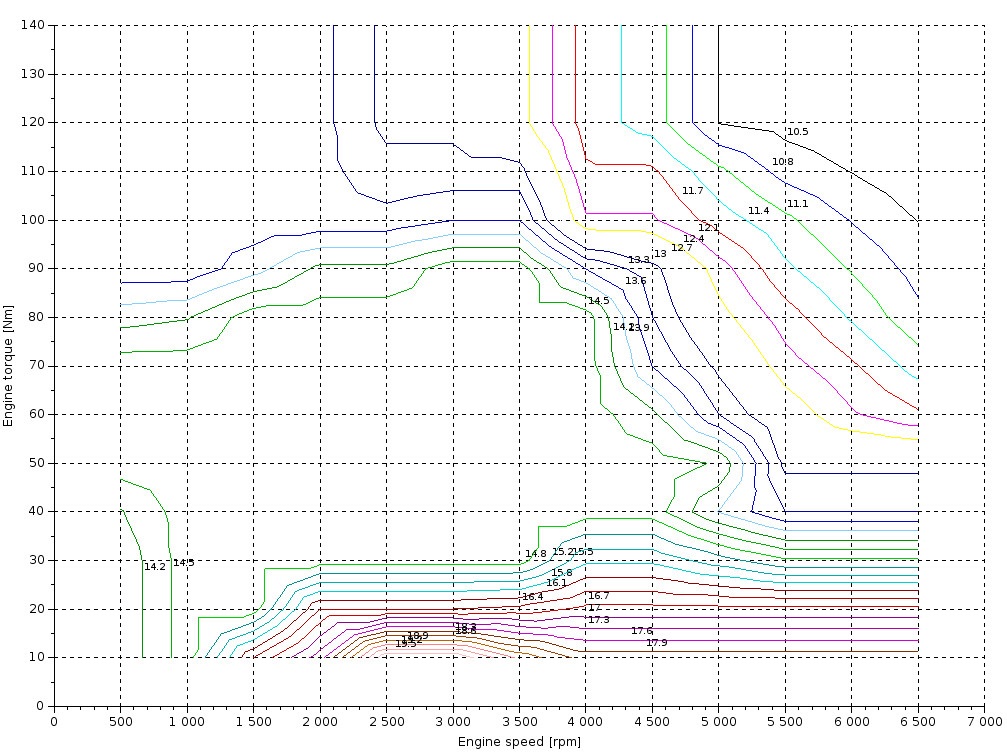
Image: Air fuel circuit using Scilab
4. How is the stoichiometric ratio of air and fuel calculated
To understand how the stoichiometric ratio of air and fuel is calculated, we need to look at the process of burning fuel. Combustion is basically a chemical reaction (called oxidation ) in which fuel mixes with oxygen to produce carbon dioxide (CO 2 ), water (H 2 O), and energy (heat). Note that activation energy (spark or high temperature) is required for the oxidation reaction to take place. In addition, the net reaction is strongly exothermic (with the release of heat).

Example 1. For a better understanding, consider the reaction of methane oxidation . This is a fairly common chemical reaction, since methane is the main component of natural gas (about 94%).
Step 1 . Write a chemical reaction (oxidation)
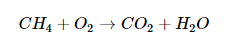
Step 2 . Balance the equation

Step 3 . Write the standard atomic weight for each atom
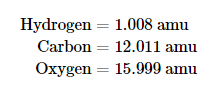
Step 4 . Calculate the mass of fuel, which is 1 mole of methane, consisting of 1 carbon atom and 4 hydrogen atoms.
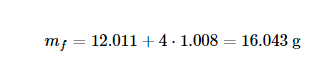
Step 5 . Calculate the mass of oxygen that consists of 2 moles, each mole consists of 2 oxygen atoms.

Step 6 . Calculate the required mass of air that contains the estimated mass of oxygen, given that air contains about 21% oxygen.
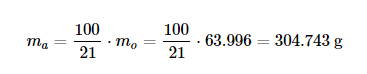
Step 7 . Calculate the air-fuel ratio using equation (1)
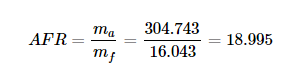
The calculated AFR for methane does not exactly correspond to that indicated in the literature. The difference may be due to the fact that in our example we made several assumptions (the air contains only 21% oxygen, the products of combustion are only carbon dioxide and water).
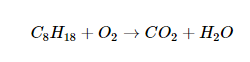
Example 2. The same method can be used for burning gasoline. Given that gasoline consists of isooctane (C 8 H 18 ), calculate the stoichiometric ratio of air and fuel for gasoline .
Step 1 . Write a chemical reaction (oxidation)
Step 2 . Balance the equation

Step 3 . Write the standard atomic weight for each atom
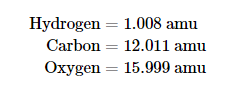
Step 4 . Calculate the mass of fuel, which is 1 mole of isooctane, consisting of 8 carbon atoms and 18 hydrogen atoms

Step 5 . Calculate the mass of oxygen, which consists of 12.5 moles, each mole of which consists of 2 oxygen atoms

Step 6 . Calculate the required mass of air that contains the calculated mass of oxygen, given that air contains about 21% oxygen

Step 7 . Calculate the air-fuel ratio using equation (1)
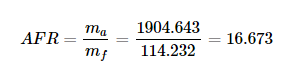
Again, the calculated stoichiometric ratio of air to fuel for gasoline is slightly different from that reported in the literature. Thus, the result is acceptable because we made many assumptions (gasoline contains only isooctane, air contains only 21% oxygen, the only products of combustion are carbon dioxide and water, combustion is ideal).
5. Lambda air-fuel coefficient
We saw what it is and how to calculate the stoichiometric (ideal) ratio of air and fuel. In fact, internal combustion engines do not operate with ideal AFR, but with values close to it. Therefore, we will have the ideal and actual air/fuel AFR ratio. The ratio between the actual air-fuel ratio (AFR fact ) and the ideal/stoichiometric air-fuel ratio (AFR ideal ) is called the equivalent air-fuel ratio or lambda (λ).
λ=AFRactualAFRideal(3)
For example, the ideal air-fuel ratio for a gasoline engine is 14.7:1. If the actual/real AFR is 13.5, the lambda equivalence ratio will be:
λ=13,514.7=0.92
Depending on the lambda value, the engine operates with a lean, stoichiometric or rich air-fuel mixture.
| Equivalence factor | Type of air-fuel mixture | description |
| λ < 1.00 | Rich | There is not enough air for complete combustion of the amount of fuel; after combustion, unburned fuel remains in the exhaust gases |
| λ = 1.00 | stoichiometric (ideal) | The mass of air is sufficient for complete combustion of fuel; after combustion, there is no excess oxygen and unburned fuel in the exhaust gases |
| λ > 1.00 | Thin | More oxygen than is needed for complete fuel combustion; after combustion, there is an excess of oxygen in the exhaust gases |
Depending on the type of fuel (gasoline or diesel) and the type of injection (direct or indirect), the internal combustion engine can work with a lean, stoichiometric or enriched air-fuel mixture.
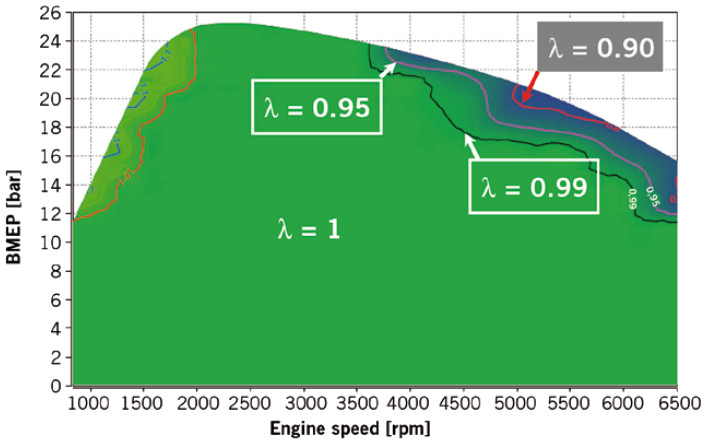
Image: Ecoboost 3-cylinder direct injection petrol engine (lambda map)
Author: Ford
For example, the Ford Ecoboost 3-cylinder engine operates with a stoichiometric air-fuel ratio for idle and mid-engine speeds and the full load range, and with a rich air-fuel mixture at high speed and load. The reason it runs with a rich mixture at high revs and loads is to cool the engine . Additional fuel (which will remain unburned) is injected to absorb heat (via vaporization), thus lowering the temperature in the combustion chamber.
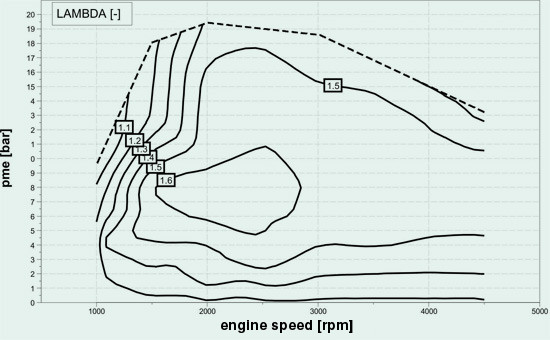
Image: diesel engine (lambda map)
Image: wtz.de
A compression ignition (diesel) engine runs on a lean air-fuel mixture all the time, the value of the equivalence ratio (λ) depends on the operating point of the engine (speed and torque). The reason for this is the principle of operation of a diesel engine: load control is not due to the mass of air (which is always in excess), but due to the mass of fuel (injection time).
Remember that the stoichiometric equivalence ratio (λ = 1.00) means an air-to-fuel ratio of 14.7:1 for gasoline engines and 14.5:1 for diesel engines.
6. Air-fuel ratio and engine performance
Engine performance in terms of power and fuel consumption is highly dependent on the air-fuel ratio. For a gasoline engine, the lowest fuel consumption is achieved at a lean AFR. The main reason is that there is enough oxygen to completely burn all the fuel, which is converted into mechanical work. On the other hand, maximum power is achieved by rich air-fuel mixtures. As explained earlier, putting more fuel into the cylinder at high engine load and speed cools the combustion chamber (through fuel vaporization and heat absorption), which allows the engine to produce maximum engine torque, therefore maximum power.
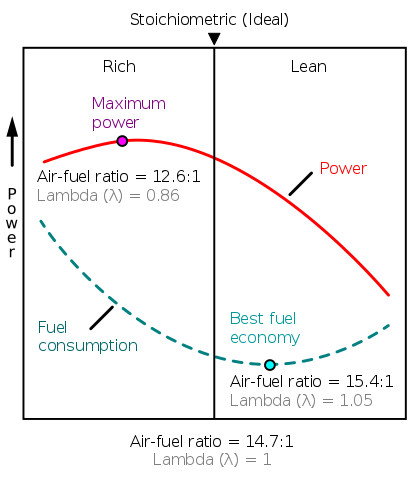
Image: function of engine power and fuel consumption air-fuel ratio (lambda)
In the figure above, we can see that we cannot get maximum engine power and lowest fuel consumption with the same air to fuel ratio. The lowest fuel consumption (best fuel economy) is achieved by lean air-fuel mixtures with an AFR of 15.4:1 and an equivalence ratio (λ) of 1.05. Maximum engine power is achieved with enriched air-fuel mixtures with an AFR of 12.6:1 and an equivalence ratio (λ) of 0.86. At a stoichiometric air-fuel mixture (λ = 1), there is a compromise between maximum engine power and minimum fuel consumption.
Compression ignition (diesel) engines always operate on a lean air-fuel mixture (λ > 1.00). Most modern diesel engines operate with λ between 1.65 and 1.10. The maximum efficiency (lowest fuel consumption) is reached at λ = 1.65. Increasing the amount of fuel above this value (up to 1.10) will result in more soot (unburned fuel particles).
There is an interesting study done by R. Douglas on 2-stroke engines. In his doctoral thesis " Research of the closed cycle of a two-stroke engine ", R. Douglas offers a mathematical expression of the combustion efficiency function (η λ ) from the equivalence ratio (λ).
For spark ignition (gasoline engine) with an equivalence ratio from 0.80 to 1.20, the combustion efficiency is:
ηλ=−1.6082+4.6509⋅λ–2.0746⋅λ2(4)
For compression ignition (diesel engine) with an equivalence ratio of 1.00 to 2.00, the combustion efficiency is:
ηλ=−4.18+8.87⋅λ–5.14⋅λ2+λ3(5)
For diesel engines, if the equivalence ratio is greater than 2.00, the combustion efficiency is maximum (1.00 or 100%).
We can use a Scilab script to plot the variation of the combustion efficiency function of the equivalence factor.
lmbd_g = [0.80:0.01:1.20];
lmbd_d = [1.00:0.01:2.00];
eff_lmbd_g = -1.6082+4.6509*lmbd_g-2.0746*lmbd_g.^2;
eff_lmbd_d = -4.18+8.87*lmbd_d-5.14*lmbd_d.^2+lmbd_d.^3;
plot(lmbd_g,eff_lmbd_g,'b','LineWidth',2)
hold
plot(lmbd_d,eff_lmbd_d,'r','LineWidth',2)
xgrid()
xlabel('$\lambda \text{ [-]}$')
ylabel('$\eta_{\lambda} \text{ [-]}$')
title('x-engineer.org')
legend('gasoline','diesel',4)
Executing the Scilab instructions above produces the following graphical window.
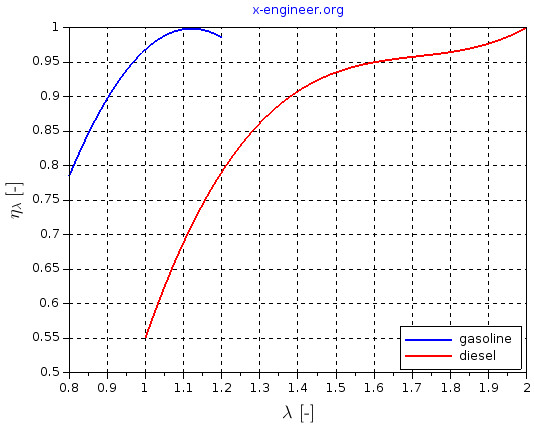
Figure: combustion efficiency function of equivalence ratio
As you can see, a compression ignition (diesel) engine with a stoichiometric ratio of air and fuel has very low combustion efficiency. The best combustion efficiency is achieved at λ = 2.00 for diesel and λ = 1.12 for spark ignition (gasoline) engines.
7. Influence of the ratio of air and fuel on engine emissions
The exhaust gas emissions of internal combustion engines are largely dependent on the ratio of air and fuel (equivalence factor). The main emissions of exhaust gases in the internal combustion engine are shown in the table below.
| Emission of exhaust gases | description |
| CO | carbon monoxide |
| HC | hydrocarbon |
| NOx | nitrogen oxides |
| Soot | unburnt fuel particles |
For a gasoline engine, CO, HC, and NOx emissions are largely influenced by the air-fuel ratio . CO and HC are mainly produced with rich air-fuel mixtures, while NOx with lean mixtures. Hence, there is no fixed air-fuel mixture for which we can obtain a minimum for all exhaust gases.
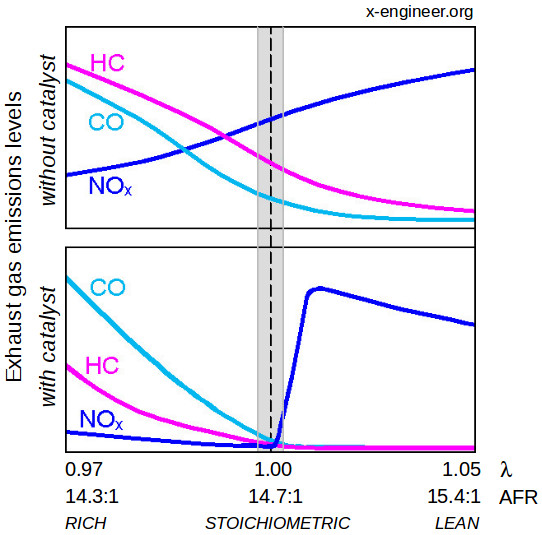
Figure: Gasoline engine catalyst efficiency as a function of air-fuel ratio
The three-component catalytic converter (TWC) used in gasoline engines is most efficient when the engine is operated within a narrow range around the stoichiometric air-fuel ratio. TWC converts 50 to 90% of hydrocarbons and 90 to 99% of carbon monoxide and nitrogen oxides when the engine operates with λ = 1.00.
8. Lambda control with a closed combustion circuit
In order to meet exhaust emission regulations, it is very important for internal combustion engines (especially gasoline engines) to have precise control of the air-fuel ratio. Thus, all modern internal combustion engines have a closed circuit for adjusting the ratio of air and fuel (lambda) .
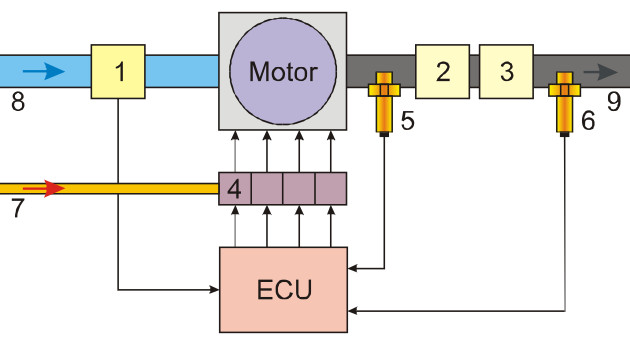
Image: Internal combustion engine with closed loop lambda control (gasoline engines)
- Air flow sensor
- Primary catalyst
- Secondary catalyst
- Fuel injector
- Front lambda (oxygen) sensor
- Lambda (oxygen) sensor
- Fuel supply circuit
- Intake manifold
- Exhaust manifold
A critical component for system operation is the lambda (oxygen) sensor . This sensor measures the level of oxygen molecules in the exhaust gases and sends the information to the engine's electronic control unit (ECU). Based on the reading of the oxygen sensor, the EBC of the gasoline engine adjusts the fuel mass level to maintain the air-fuel ratio at the stoichiometric level (λ = 1.00).
For example (in gasoline engines), if the level of oxygen molecules is above the threshold value for the stoichiometric level (so we have a lean mixture), during the next injection cycle, the amount of fuel injected will be increased to use the excess air. Keep in mind that the engine will always go from lean to rich between injection cycles, giving an "average" stoichiometric ratio of air to fuel.
For diesel engines, since they always run on a lean fuel ratio, lambda control is performed in a different way. The ultimate goal remains the same - control of exhaust gas emissions.